Market trendsBenchmarking
On-demand webinar: Berlin tech salaries 2026 – What the numbers actually say
Handpicked Berlin and Ravio are unpacking five findings from the 2026 Berlin Tech Salary Survey – with European benchmark data added in real time.


82% of People and Reward Leaders say lack of clarity around career progression is their biggest retention challenge – ranking even higher than compensation issues.
Promotion rates reveal whether your company is delivering on career advancement expectations and, when benchmarked against your industry peers, tells you if you're creating enough growth opportunities to retain your top talent.
So, let’s take a look at the latest promotion data from Ravio's 2026 Compensation Trends Report – exploring typical promotion rates and promotion salary increases, as well as how they vary across locations, functions, and company stages.
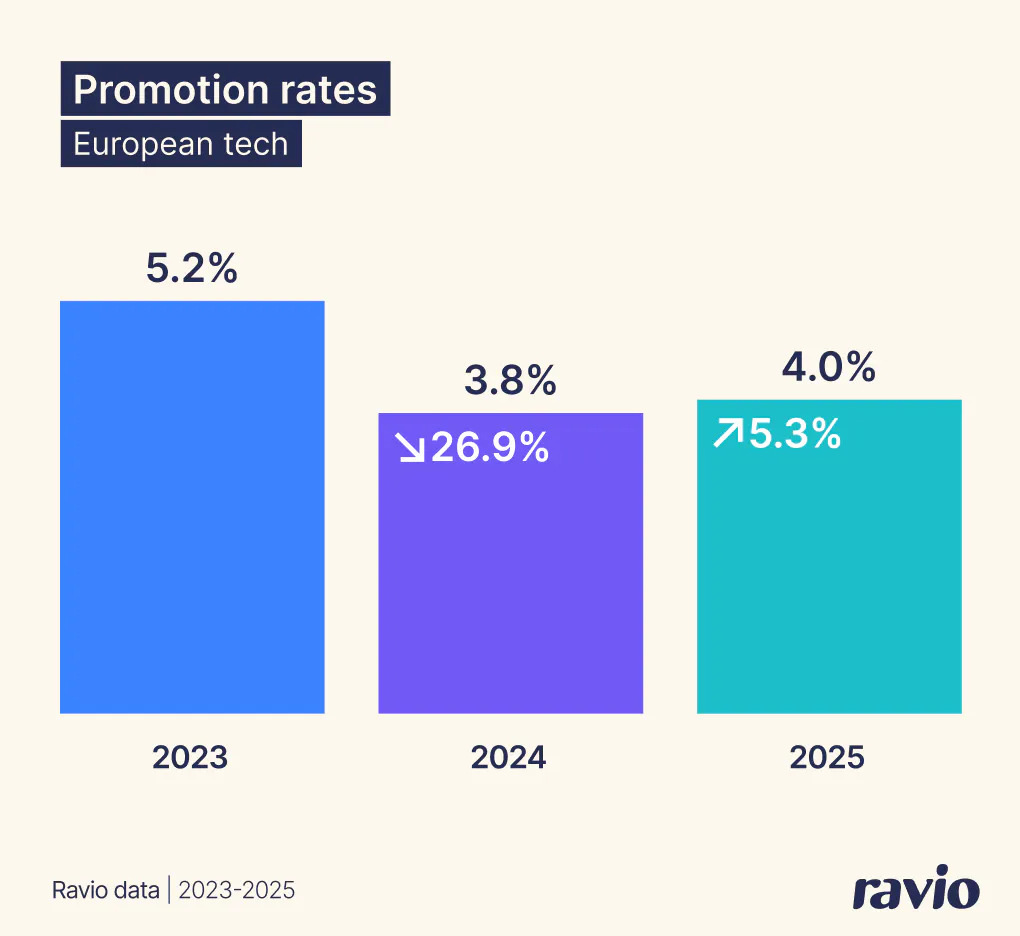
The average promotion rate is 4.0% (Ravio 2026 Compensation Trends report).
This represents the percentage of employees who received a promotion in the past 12 months (October 2024 to October 2025) – where ‘promotion’ is defined as a pay increase of at least 15%, the minimum raise typically associated with advancing to a more senior role.
The average promotion rate edged up slightly this year from 3.8% in 2024, but remains well below the 5.2% seen in 2023 – suggesting companies are taking a more selective approach to employee career advancement.
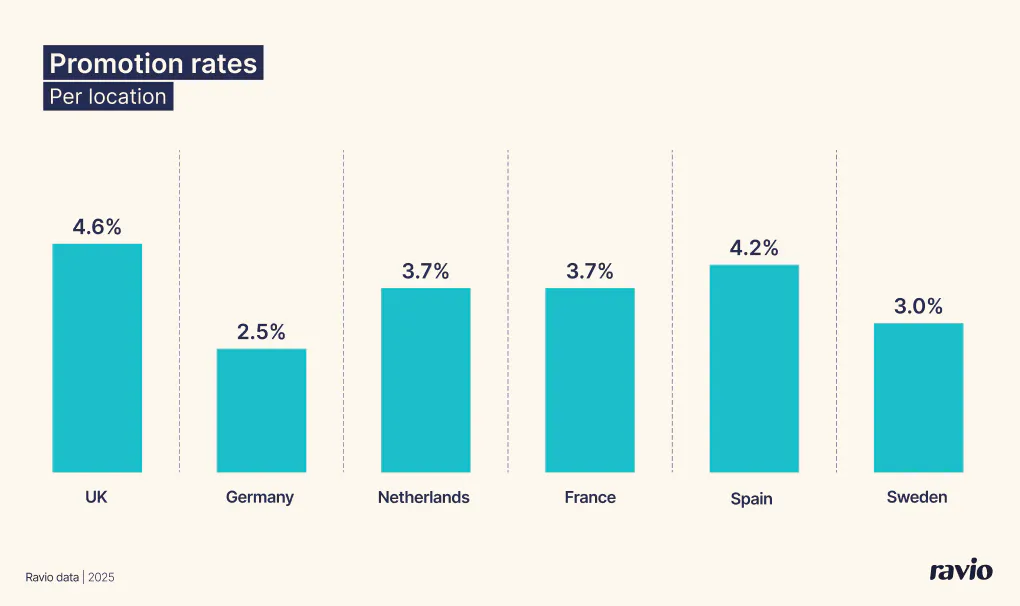
Promotion rates vary moderately across European markets:
The UK leads with the highest internal promotion rate at 4.6%, while Germany shows the most conservative approach to promotions at just 2.5% – less than half the UK rate.
France and the Netherlands both sit at 3.7%, with Spain slightly higher at 4.2%.
Sweden's below-average promotion rate of 3.0% is particularly interesting given that median salaries for core roles like Software Engineering, Product Management, and Sales in Sweden have increased significantly in recent years. This suggests Swedish companies may be investing compensation budget into maintaining competitive salaries for new hires rather than promotions for existing employees.
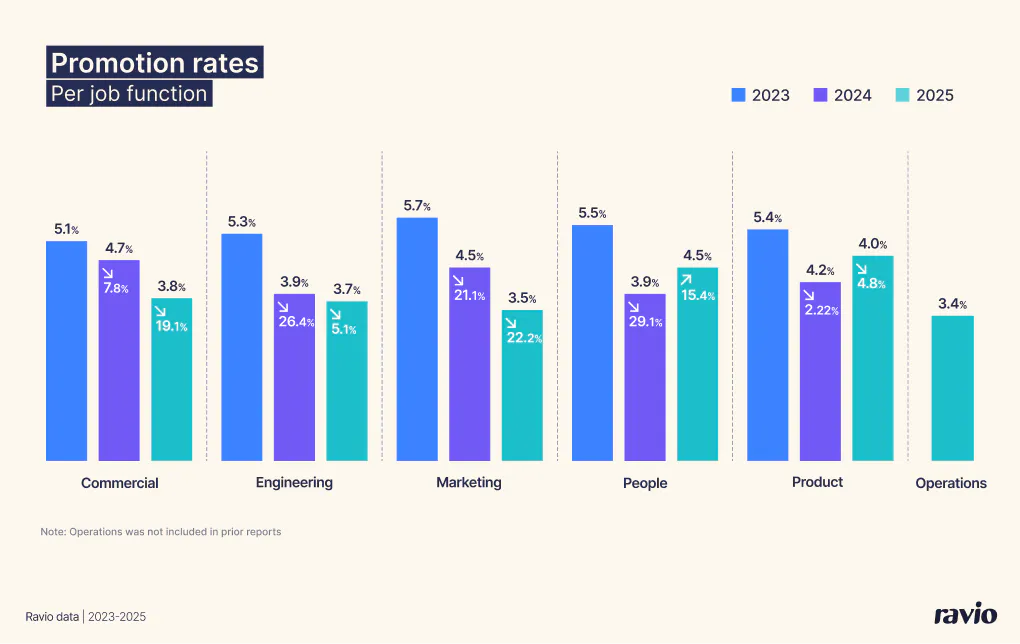
Promotion rates across job functions reveal clear winners and losers in 2025:
People teams have seen the highest promotion rates in the past year at 4.5%, and the biggest increase in promotions since last year. Companies are investing in progression for their People function – perhaps a response to the high attrition rates seen in this function last year.
On the other end of the spectrum, Marketing (3.5%) and Operations (3.4%) show the lowest promotion rates, continuing the pattern of compensation constraints in Operations roles.
"The shift we're seeing in Operations is very real. As AI engineers pick up workflow automation, data handling, and even parts of customer support, the traditional Ops role is being redefined. Companies are experimenting with leaner Ops teams, and these compensation trends reflect that uncertainty."

Elena Pantazi
Talent and Portfolio Development Partner at Northzone
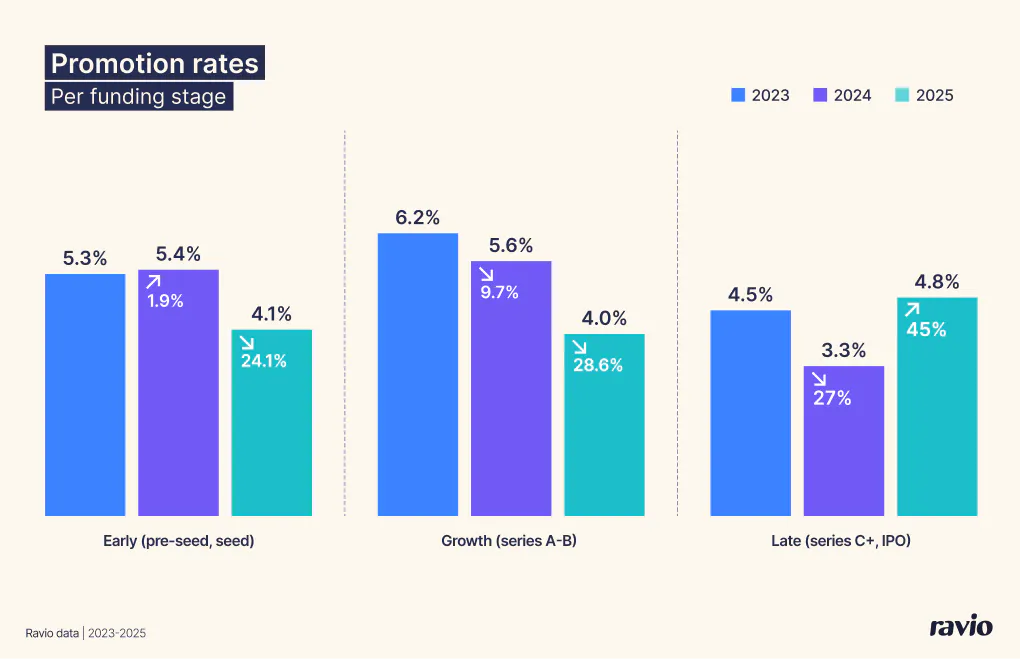
Promotion rates at late-stage startups (Series C, IPO+) have seen a substantial increase this year, a complete reversal from last year when they had the lowest rates:
This mirrors the salary increase trends, where early-stage companies dropped to just 3.0% average increases.
Both patterns point to the same reality: early-stage companies are operating with tighter compensation budgets as they prioritise extending runway and controlling costs. Late-stage companies, with more stable finances, can afford to invest in both salary increases and career progression for their teams.
"Early-stage funding is still available, but mid to later stage funding is drying up. This means startups need to show profitability much earlier – the days of relying on a string of raises are over. The money they're getting now needs to last much longer than it used to."

Matt McFarlane
Director at FNDN
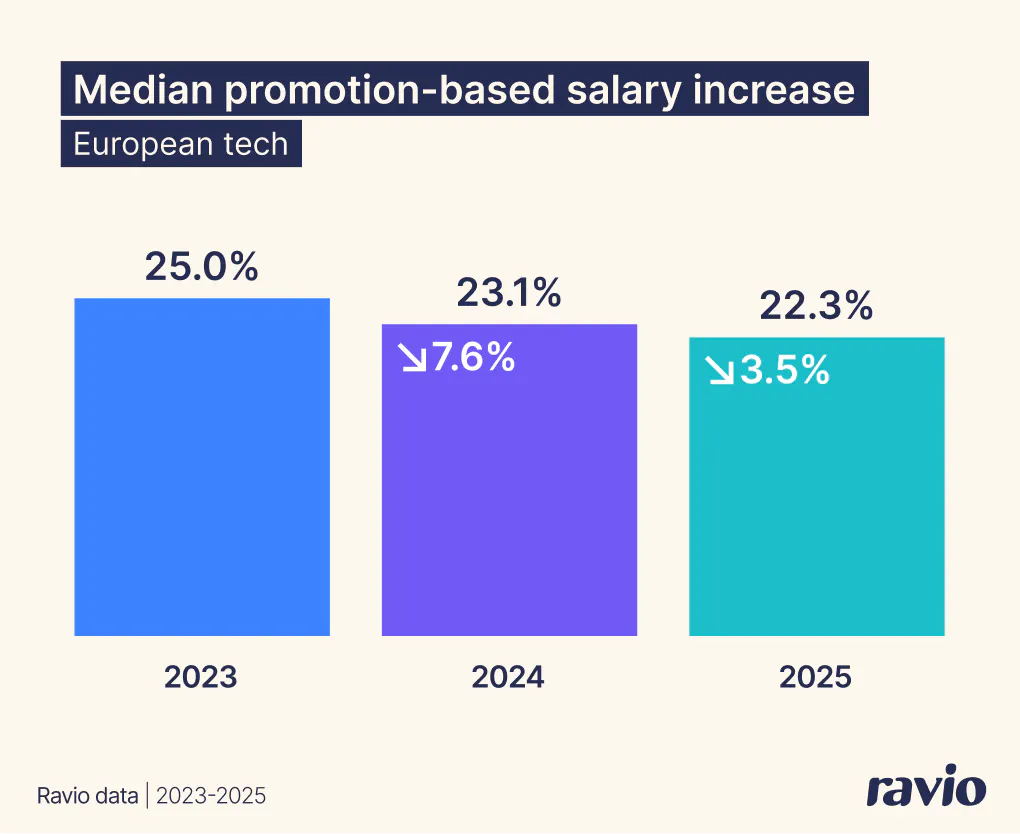
The average salary increase received at promotion in 2025 is 22.3% (Ravio 2026 Compensation Trends report).
This is the median pay bump employees receive when promoted to a more senior role – typically a substantially larger increase than typical in-role salary adjustments, to bring an employee's pay in line with their new level of seniority and increased responsibilities.
The average promotion salary increase has declined slightly over the past few years, down from 23.1% in 2024 and 25.0% in 2023. This suggests companies are offering more modest pay increases with promotions, possibly reflecting tighter compensation budgets overall.
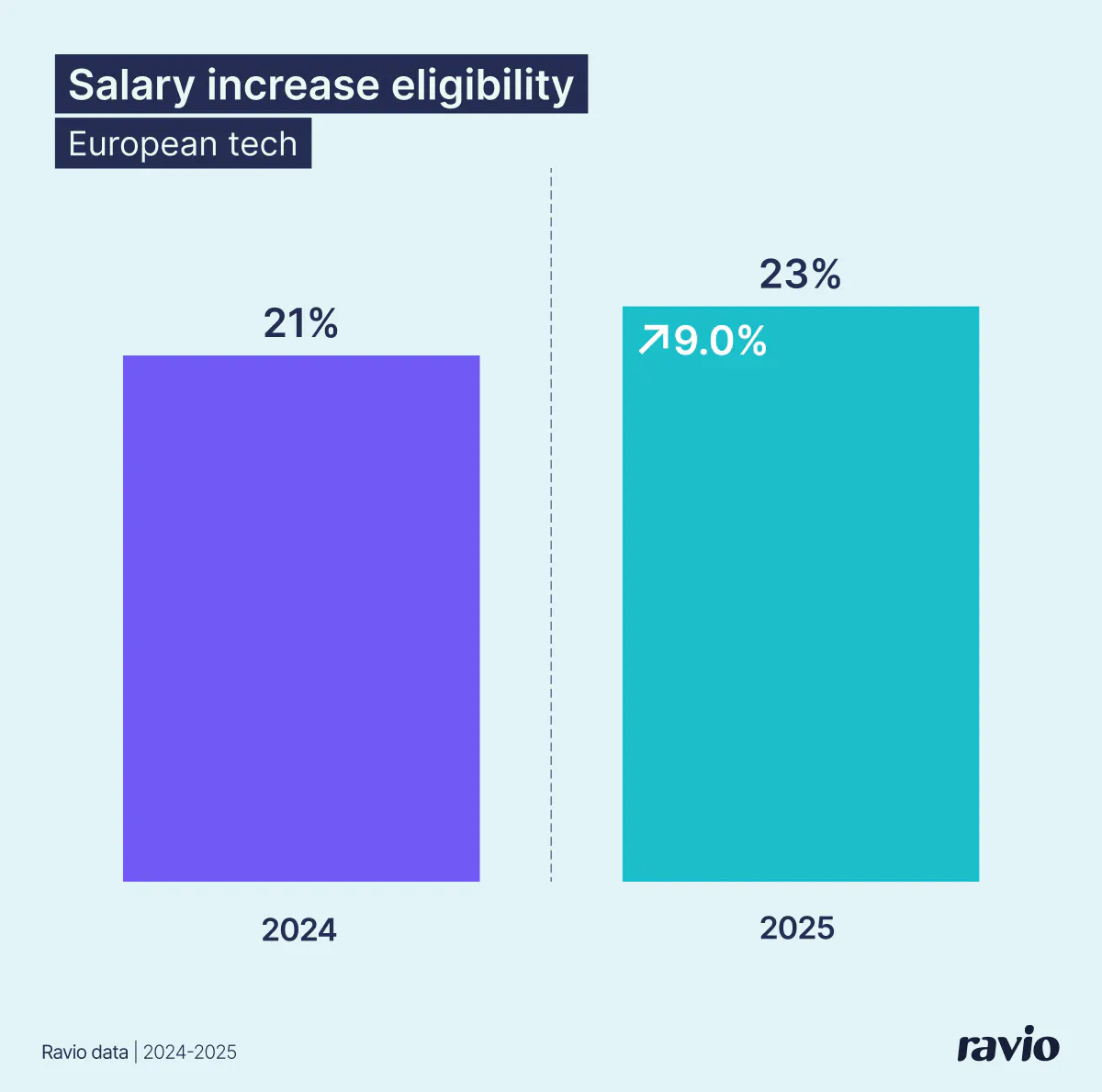
📊 Most employees (73%) received no salary increase or promotion in 2025
When we combine promotion data with salary increase eligibility, 73% of the European tech workforce has received no salary adjustment at all in the last 12 months:
Companies maintaining salary freezes for the majority of their workforce may find their compensation becoming uncompetitive, particularly for employees who have been in role for multiple years without adjustment.
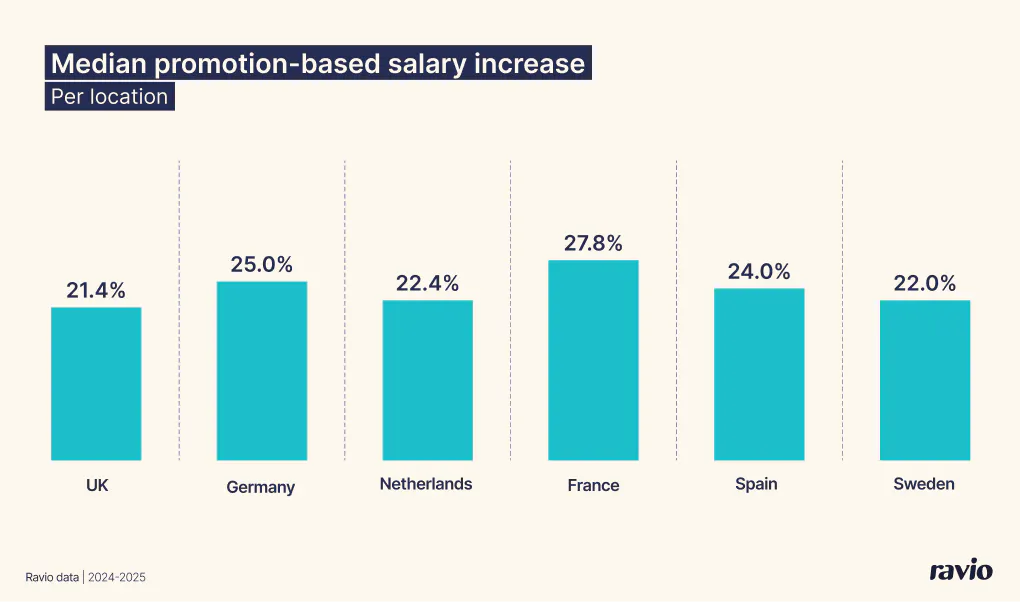
Promotion salary increases vary significantly across European markets:
Interestingly, one overall theme is that countries with higher promotion rates tend to offer smaller increases.
For instance, the UK has the highest promotion rate (4.6%) but lowest increase (21.4%), while Germany shows the opposite pattern (2.5% promotion rate, 25.0% increase).
This suggests different market approaches: some promote more frequently with modest increases, while others promote employees more slowly but with more significant pay changes.
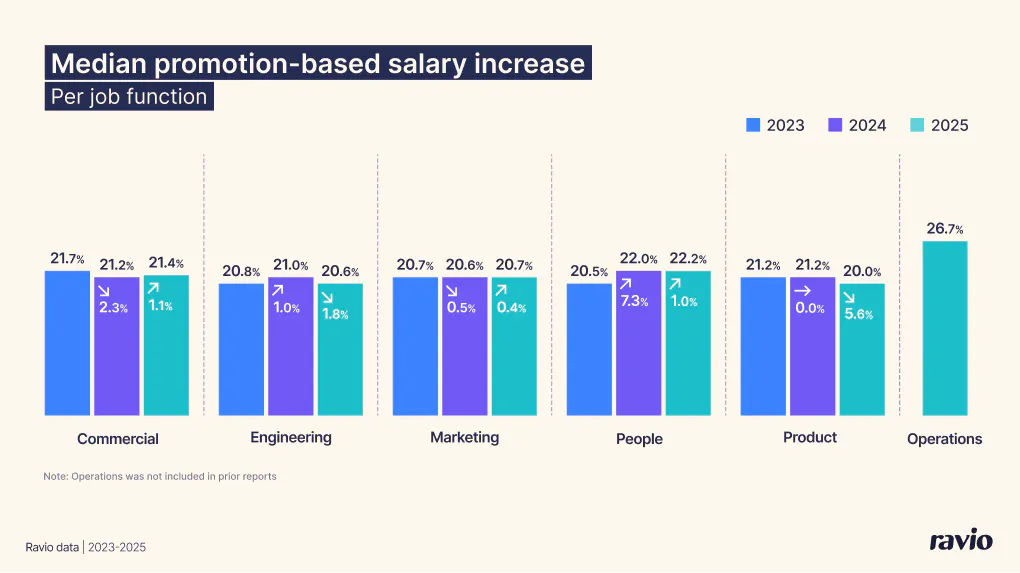
Most functions cluster within a narrow 20-22% range – suggesting this represents the standard expectation for promotion-based salary adjustments in European tech:
Operations shows the highest promotion increases at 27%, a notable outlier considering the constraints seen in promotion rates and salary eligibility for this function. This could reflect the bifurcation of operations roles in the AI era – while routine positions face automation pressures (hence fewer promotions), more strategic operations roles may command premium increases as their importance heightens.
Marketing demonstrates remarkable stability at around 21% for three consecutive years, while Engineering (21%), Product (20%), Commercial (21%), and People (22%) show only minor variations.
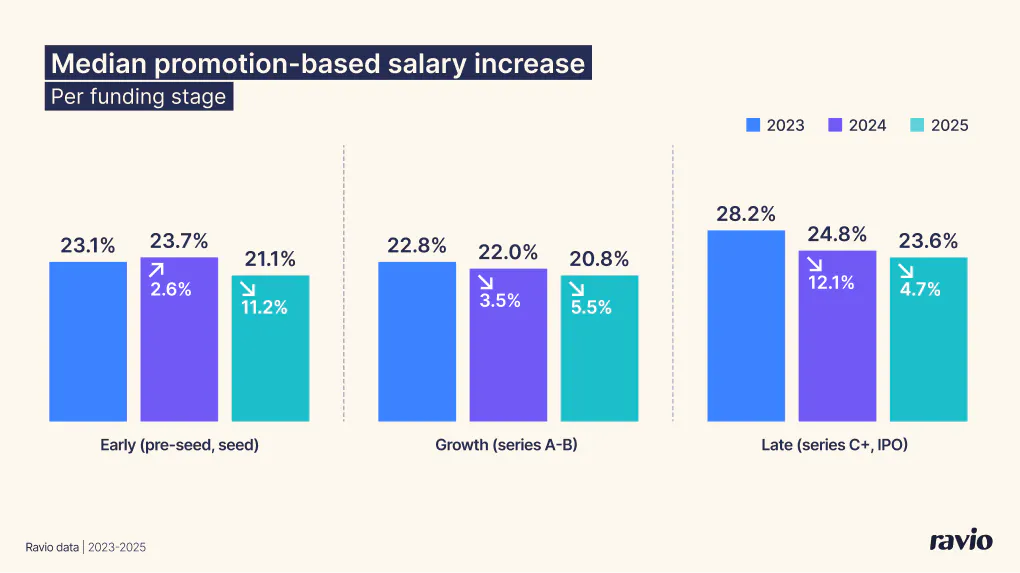
Early-stage companies show the steepest decline in promotion-based salary increases:
Early-stage companies saw an 11% decline in promotion increases to just 21%, aligning with the reductions seen at early-stage companies across salary increases and promotions more generally.
"With VCs demanding sustainable growth over rapid scale, early-stage companies must optimise compensation budgets whilst building a relatively new employee experience. Success means thinking strategically across all People initiatives, and spending wisely."

Rob Green
Founder of Darwin Total Rewards
Despite increasing their promotion rates significantly this year, late-stage companies maintain the highest promotion increases. Late-stage companies typically have more levels in their organisation structure which allows for more promotion potential, and their stronger financial position may also allow for both more frequent and more sizable promotions.
Employee promotion is when an individual advances to a more senior role within their organisation, typically involving increased responsibilities, greater impact on the business, and a corresponding salary increase.
The promotion rate formula is: (Number of employees promoted / Total average headcount) × 100. This gives you the promotion rate as a percentage.
For example, if 40 employees were promoted over 12 months and your average headcount during that period was 1,000, your promotion rate would be 4.0%.
According to Ravio's 2026 Compensation Trends Report, the average promotion rate in 2025 is 4.0%.
A good promotion rate depends on your industry, company stage, and organisational structure. What matters most is whether your promotion rate aligns with strategic objectives and employee expectations – too low may signal limited growth opportunities, whilst too high could indicate an overly complex organisational structure or unsustainable pay progression.
According to Ravio's 2026 Compensation Trends Report, the average promotion rate is 4.0% – but with variance depending on location, company size and stage, and job function.
Communicating a promotion effectively starts long before the actual announcement – pay and progression should be ongoing conversations throughout the year, not one-off events. When employees understand your career framework and receive regular feedback on their development, promotions feel like natural progressions rather than surprises.
When it comes time to deliver the news, some effective tactics include:
Justifying a promotion should be based on your company's job levelling framework and career progression criteria, not subjective opinion. Document evidence that the employee is already operating at the next level: their scope of responsibilities, business impact, level of autonomy, and technical expertise, and then compare their performance against the competencies defined for the target level.
Conduct an exit interview to understand their perspective and whether the decision could have been communicated better. Review whether your promotion criteria are clearly communicated to all employees, whether the employee received adequate feedback on what they needed to demonstrate for promotion, and whether your promotion rates are competitive with the market. If this becomes a pattern, it may signal a need to review your organisational structure, career framework, or promotion budget.
First, understand their reasons through an open conversation – they may be content in their current role, concerned about work-life balance, or worried about managing people. Sometimes managers weren't involved in the promotion decision, or didn't understand the employee's career goals. Respect their decision and discuss alternative growth opportunities that align with their preferences, such as expanding expertise, taking on strategic projects, or increasing compensation within their current level. Not everyone wants to climb the traditional career ladder.
Your monthly dose of market insights and expert perspectives
Handpicked Berlin and Ravio are unpacking five findings from the 2026 Berlin Tech Salary Survey – with European benchmark data added in real time.

AI compensation and hiring trends: 88% growth in AI hiring, 12% salary premiums, and how demand for AI skills is reshaping the tech talent market.

European tech has stabilised after years of volatility – but AI and pay transparency mean new transformation. Nico Kaml, Karam Deo, Chloe Paramatti, and Evert Kraav unpack the latest compensation trends for 2026 planning.

