Why trust Ravio's data over a salary survey company with a huge dataset
Bigger datasets tend to be broad but not always reliable. Learn how Ravio prioritises data quality over quantity to give fresh, accurate, and relevant pay benchmarks.

There's no shortage of options when it comes to salary benchmarking.
Free salary calculator tools from recruiters like Hays and Michael Page. Employee-reported platforms like Glassdoor. Annual surveys from traditional consultancies like Mercer. Purpose-built compensation benchmarking platforms that pull directly from HR systems.
It’s easy to find data, but ensuring that data will actually hold up when you're making a hiring decision, defending a salary band to leadership, or working out whether your team is paid fairly isn’t always so easy.
Some tools are built specifically for that.
Others are useful for a quick sanity check – but will leave you exposed the moment a decision gets scrutinised.
The difference isn't always obvious from the outside.
So in this guide, we’ll help you:
When you're evaluating options for compensation benchmarking, it's important to know that not all salary benchmarking tools are built the same way.
A free salary calculator by a job platform isn’t going to give you the same insights as purpose-built compensation benchmarking software.
The most important difference is where the underlying data comes from and how it's turned into a benchmark. That determines how current, accurate, and relevant the salary benchmarks actually are – and, in turn, how confident and defensible the compensation decisions you use them to make are.
There are five broad categories to understand – here's a quick summary of the differences, before we dive into a more detailed explanation:
Integration-based platforms (e.g. Ravio, Pave) | Salary survey providers (e.g. Mercer, Radford, Brightmine) | HRIS platforms with benchmarking module (e.g. HiBob, Lattice) | Job ad aggregators (e.g. HRDataHub) | Unverified tools, calculators, and guides (e.g. Glassdoor, Hays) | |
|---|---|---|---|---|---|
Data delivery | External benchmarks and internal salary data accessible 24/7 via a software platform | Benchmarks delivered in a spreadsheet or online portal – software capabilities are limited. Payscale and CompAnalyst aggregate multiple survey sources into a platform | Licensed into your existing HRIS platform – convenient but limited | Salary ranges accessible via a dedicated platform or free online tool | Salary range via free online calculator or downloadable guide |
Data recency | Benchmarks updated regularly as HRIS data refreshes continuously at source | Point-in-time data gathered via surveys conducted annually or quarterly. Payscale's HRIS-integrated data refreshes more frequently | Inherits the refresh cadence of the underlying survey source – typically annual or quarterly, with limited transparency on timing | Updated daily or weekly from job posting activity | Unknown for job ad tools. Average from all-time submissions for Glassdoor |
Accuracy and reliability | High accuracy – data pulled directly from HRIS systems, no manual submission risk. Human validation adds a further quality layer | Risk of human error due to manual salary survey submissions | Inherits the accuracy limitations of the underlying survey source, with limited additional validation | Reflects advertised pay, not actual pay – ranges are often wide and unverified | Highly unreliable – unverified, no methodology, no quality controls |
Peer group relevance | Targeted data pools with filters for location, industry, company stage, and headcount. Percentile breakdowns available to position pay deliberately against the market | Broad global data pool, skewed toward large legacy enterprises. Filtered peer group reports available at added cost. Payscale and CompAnalyst offer some additional filtering | Reflects the underlying survey pool – typically broad and enterprise-weighted | No peer group filtering – data reflects all companies posting jobs, regardless of size, industry, or stage | No peer group filtering. No percentile breakdowns |
Job mapping | Automated job mapping against the provider's framework, ensuring like-for-like comparisons | Manual mapping against a complex job library. Payscale offers algorithm-assisted matching; CompAnalyst uses AI-guided matching | Manual mapping against the underlying survey provider's job catalogue | Keyword-based job title search – no formal level framework | No mapping |
Compensation tools | Typically include salary bands, pay equity analysis, and comp review workflows built on top of the benchmarking data | Piecemeal – survey data plus standalone tools or consultancy projects. Payscale and CompAnalyst include broader comp management tooling | Basic compensation tools within the wider HR platform | None beyond basic trend reports | None |
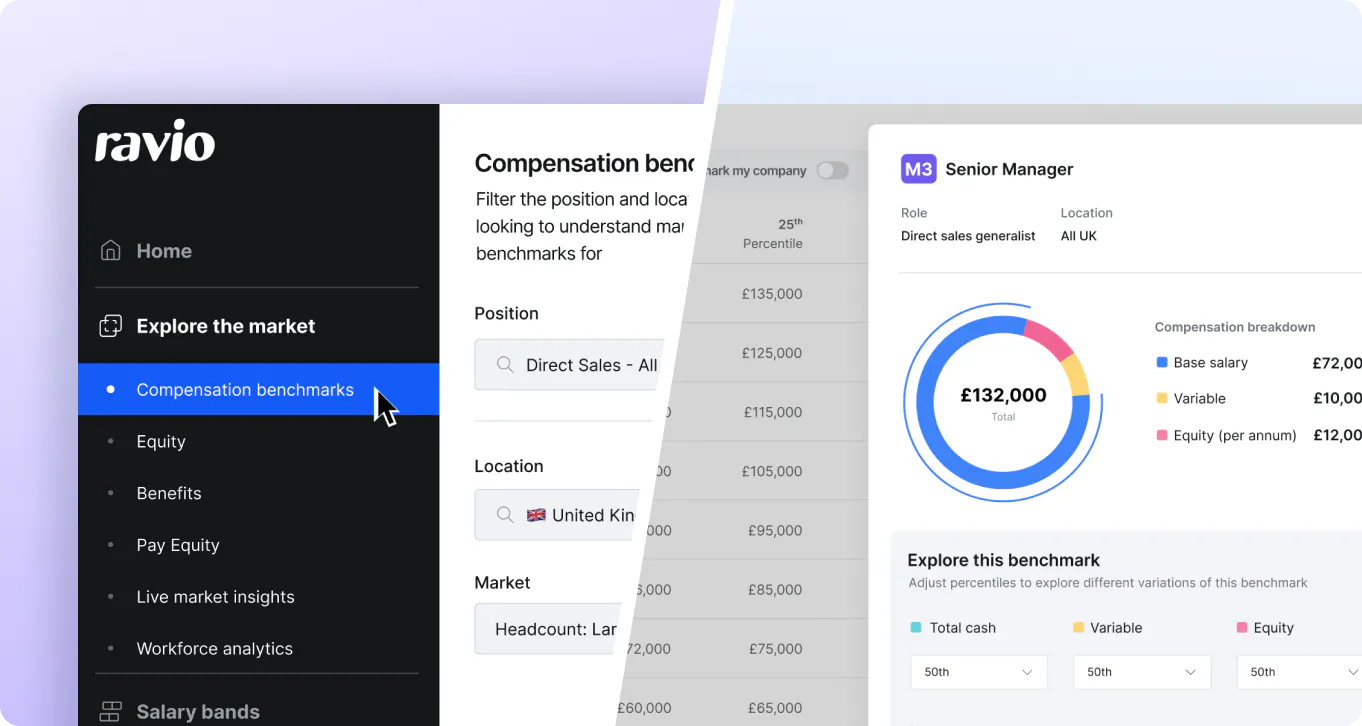
Integration-based platforms source compensation data directly from the HR systems, ATS platforms, and/or cap table tools their customers use, via live integrations.
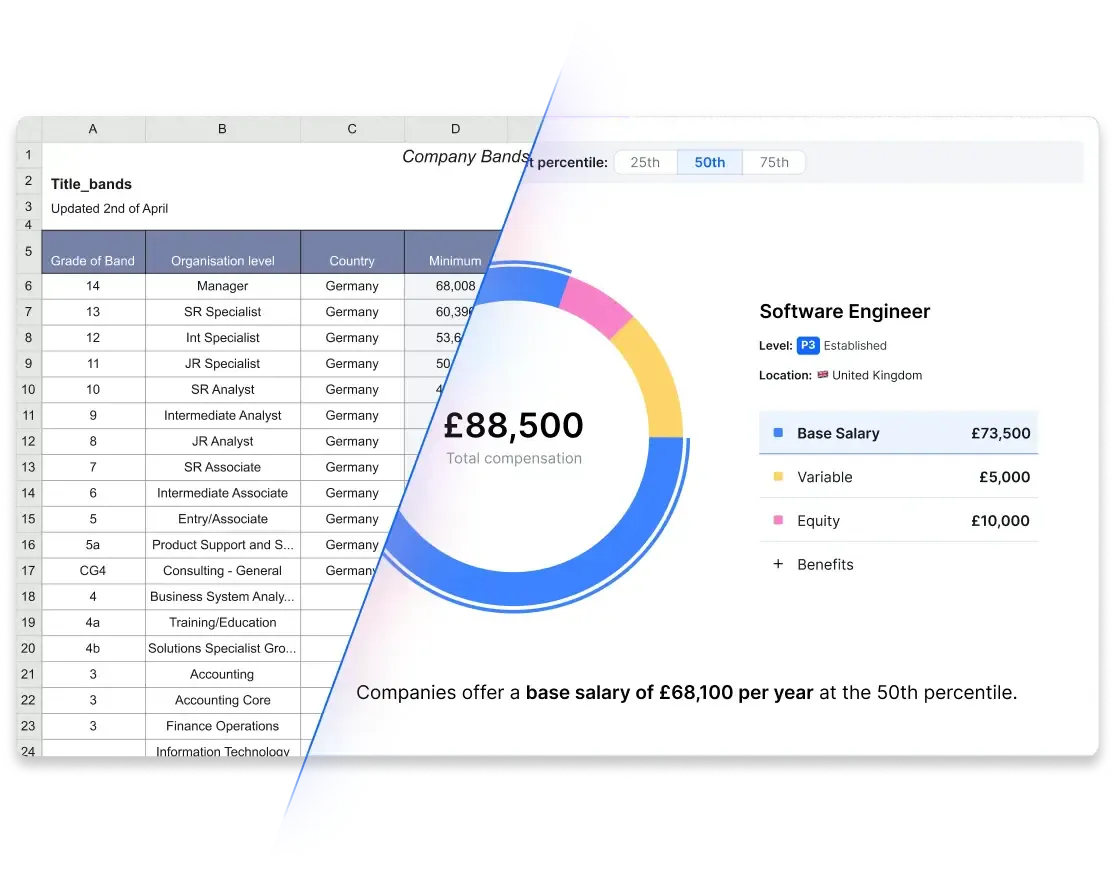
Because the data comes straight from the source rather than being manually submitted or self-reported, it's not impacted by human error. Plus, the integration means the data is continuously updated at source, more accurately reflecting current market conditions compared to survey-based alternatives.
Most platforms in this category are built for robust compensation benchmarking analysis – with filters for peer group, location, industry, company size, and funding stage, and percentile breakdowns (25th, 50th, 75th, and above) so you can position compensation deliberately against the market rather than just referencing the median.
Most also include compensation management tools like salary bands, pay equity analysis, and comp review workflows, built on top of the benchmarking data.
Examples: Ravio, Pave, Figures, Carta Total Comp, Compa
The main limitation: Coverage varies by provider. Some focus on specific geographies, industries, or compensation components – Carta, for instance, is primarily equity-focused and strongest for US private companies.
To learn more about how integration-based benchmarks work – including why they produce more accurate insights and save teams time on manual processes – book a demo with the Ravio team.
Traditional salary surveys are run by HR consultancies – Mercer, Radford, Willis Towers Watson, Korn Ferry – who invite companies to submit their compensation data manually, usually once or twice a year. That data is aggregated and sold back as benchmarks.
Salary surveys were previously the only way to access salary benchmarking data, which means the data pools are large and consultancies like Mercer and Radford have established reputations that can make leadership buy-in easier.
The trade-offs are significant though: manual submissions introduce reporting inconsistencies, annual cycles mean data can be six to twelve months old by the time you use it, and datasets skew heavily toward large legacy enterprises – which can make them less relevant for high-growth or tech-focused organisations.
Examples: Mercer, Radford, Willis Towers Watson, Korn Ferry, Brightmine, Croner, Payscale (in part)
The main limitation: Data freshness and relevance – in fast-moving markets, salary survey data is already behind by the time it's published.
Several broad HR platforms – including HiBob, Lattice, Workday – offer compensation benchmarking as a module within their wider people management suite, typically by licensing data from a traditional survey provider like Mercer.
The appeal is convenience: if you're already running HR operations in one of these platforms, accessing pay data without adding another tool has obvious advantages.
The data limitations are the same as with the underlying survey source – typically annual or quarterly refresh cycles, manual job mapping, and a participant pool weighted toward large enterprises. But it’s often compounded further, because these modules typically license only a portion of the provider's full dataset, and it's rarely clear how or when that data is updated within the platform.
Examples: HiBob, Lattice, Workday
The main limitation: Benchmarking is a secondary product. The data quality and tooling depth rarely match what a dedicated platform offers.
Some tools scrape job postings from across the web to produce salary benchmarks based on advertised pay ranges – and with pay transparency legislation like the EU Pay Transparency Directive pushing more companies to disclose salary ranges in job ads, this data source is growing.
The limitation is that job adverts reflect what companies are willing to advertise rather than what they're actually paying – giving a broad range rather than an actual salary per role, level, and location.
Ranges can also be inflated or inaccurate relative to the eventual offer a candidate receives.
Examples: HRDataHub, Compensation IQ (in part), Indeed's free salary calculator tool
The main limitation: Advertised pay and actual pay aren't the same thing. Ranges are often wide and context is limited.
Salary calculators, recruiter guides, and employee-reported tools are abundant, easy to access, and often cost nothing – but the data behind them is unverified and untrustworthy.
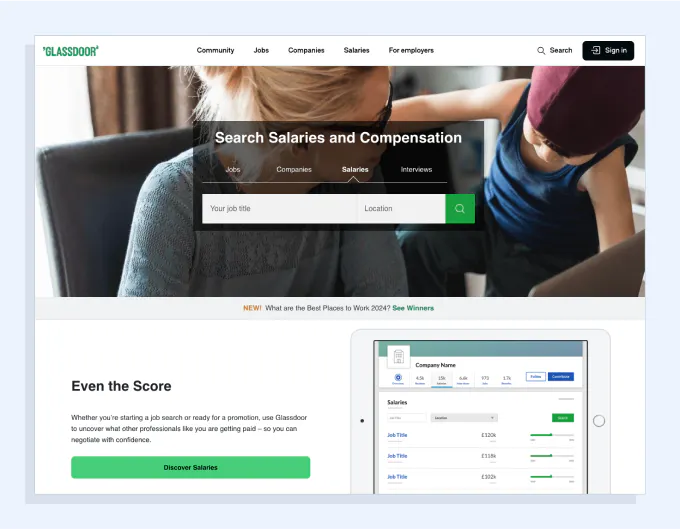
Glassdoor and Levels.fyi both collect self-reported salary submissions from individual employees to produce their salary checkers.
Recruiters like Hays, Michael Page, and Robert Half often use data gathered from the jobs they advertise and the placements they make to produce free salary reports or calculators too.
And some HR platforms produce similar free tools too – like BrightHR who aggregate payroll data into their salary benchmarking calculator.
These tools are useful for orientation and sense-checking as one-offs, but none of these are built for defensible compensation decisions – the data is unverified, there’s no methodology for producing robust benchmarks beyond averaging, and the peer group filtering is limited or absent.
Examples: Glassdoor, Levels.fyi, Hays salary guide, Michael Page salary checker, Robert Half salary guide, Indeed, BrightHR
The main limitation: No rigorous methodology, no peer group filtering, and no way to verify accuracy. A useful starting point – but not a reliable basis for pay decisions.
The right salary benchmarking software depends on what you actually need the data to do.
A free salary checker might be enough for a quick one-off sense-check before a hiring conversation. But it won't be enough for ongoing consistent and fair compensation decisions, building salary bands, running a compensation review, or defending pay decisions to leadership or regulators.
There are three core areas to consider to help you choose the right salary benchmarking tool for your organisation:
Before anything else, check whether the benchmarks actually reflect the roles, locations, and company type you need.
A large dataset isn't useful if it's built from companies nothing like yours – a dataset built primarily from large legacy enterprises in the US won't give you useful benchmarks if you're a tech scaleup hiring across multiple European markets, even if it contains millions of data points.
Coverage spans four dimensions: role and level granularity, geographic depth, peer group relevance (industry, size, and stage), and total rewards scope.
Questions to consider:
Coverage is important, but it doesn’t guarantee reliability.
The two factors that determine whether benchmarks are trustworthy are data source and benchmark methodology.
Data source determines how accurate and current the underlying data is – benchmarks built from live HRIS integrations are less prone to error than those built from manual survey submissions, job ad scraping, or employee self-reporting.
Benchmark methodology determines whether that raw data has been turned into something you can actually rely on – how outliers are handled, what sample sizes are required before a benchmark is published, and how transparent the provider is about all of the above.
Questions to consider:
Even accurate, relevant benchmarks have limited value if they can't be used by the people who need them, in the workflows where decisions actually get made.
Think about who uses benchmarking data in your organisation and when – talent teams at the point of offer, line managers reviewing their team's pay, Reward teams building salary bands or running comp reviews.
The ability to customise user access and visibility, and whether the platform includes broader compensation tools, determines how valuable a benchmarking tool will actually be for your compensation decisions and processes.
Questions to consider:
Now that you understand the landscape of options in the salary benchmarking space, let’s take a look at how different providers compare.
Below is a breakdown of 16 specific tools – what each one is, how it sources and builds benchmarks, and who it's actually best suited for.
Ravio is a compensation benchmarking platform built for high-growth tech companies, with particular depth across Europe. Data is sourced via live HRIS integrations with 1,500+ companies and validated monthly by a team of data scientists – covering base salary, equity, variable pay, and benefits across 50+ countries and 300+ roles.

Pave is a strong option for US and Canadian tech companies, with real-time data from 9,000+ companies and a solid end-to-end comp planning suite. European and global coverage exists but drops to base salary only outside North America.
Figures is a European compensation management platform offering benchmarks for base salary and variable pay through HRIS integrations and a Mercer partnership.
Carta is primarily a cap table management platform, so equity benchmarking is its strength due to cap table integrations, while salary data is less robust. Carta only works with privately held startups – primarily US-based – so its benchmarks aren’t relevant for public companies, and coverage is limited internationally.
Compa is an offers-based tool designed to supplement traditional salary surveys. It surfaces real-time data from live job offers via ATS integrations – useful for understanding what the market is actively paying right now, but no broader comp management tools.
Mercer is one of the most established global salary survey providers, with broad coverage across 100+ countries and a reputation that makes leadership buy-in easier.
Its flagship product – the Total Remuneration Survey (TRS) – is an annual employer-reported survey delivered either by spreadsheets or today via Mercer WIN, a platform built for accessing and analysing the survey data. Mercer Comptryx is a separate tech-specific dataset with quarterly updates via a give-to-get model.
Radford (Aon), Willis Towers Watson, Korn Ferry, and Culpepper operate comparable salary survey options and are worth evaluating alongside Mercer for global enterprise needs – though noting that they come with all the usual salary survey limitations.

Brightmine – formerly XpertHR and Cendex – is a UK salary survey provider that has built a benchmarking platform around its employer-reported dataset.
Monthly refreshes make it faster than most traditional survey providers, but the underlying data is still manually submitted by employers rather than sourced via HRIS integrations – so the same limitations around submission consistency and verification apply.
Croner Reward is a similar UK salary survey alternative with particular depth in sector-specific reports for charity, care, and distribution.
Payscale is a hybrid platform aggregating data from multiple sources – useful for teams that want survey data and HRIS-integrated benchmarks in one place. Data quality varies by source, and global coverage outside the US is thinner.
A US-focused aggregator combining survey data, employer HRIS uploads, and job posting ranges. CompAnalyst offers a broad feature set and strong US coverage, but data reliability varies significantly across sources – job posting ranges in particular carry the usual caveats around advertised vs actual pay.
Deel is primarily a global payroll and compliance platform, with a compensation benchmarking tool built on data from its own payroll activity across 150+ countries. It’s useful for teams already running payroll through Deel, but the dataset reflects Deel's customer base – which skews remote-first and distributed – and compensation isn’t their area of focus.
A broad HR platform that surfaces Mercer compensation data as a module within its people management suite. Convenient for existing HiBob users who want basic pay benchmarking without adding another tool – but the data carries the same limitations as the underlying Mercer survey source.
Lattice, Workday, and other HR platforms offer comparable modules on the same basis.
A benchmarking aggregator combining Mercer survey data and job posting ranges via a Lightcast integration – primarily used by public sector, nonprofit, and charity organisations in the UK and Europe. Data reliability varies across sources.
A UK-only job ad aggregator pulling from 30 million+ live and historical job listings, updated daily. More structured than a free salary checker – with trend data, sector filters, and exportable reports – but benchmarks still reflect advertised pay rather than actual compensation, and equity and benefits aren't covered.
Free and widely used for general market awareness, but data is unverified and not built for compensation planning – should not be relied on for compensation benchmarking.

Glassdoor's salary index
Started as a community tool for tech employees and has evolved into a more structured platform with an enterprise tier. The give-to-get model and document verification make it more rigorous than Glassdoor – and the equity and vesting data is a genuine differentiator for US tech roles. Coverage drops sharply outside the US and outside tech.
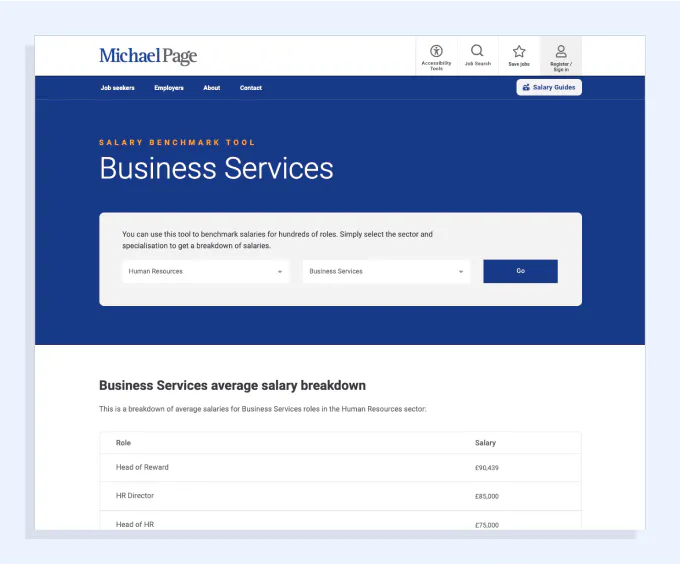
Free salary calculator tools from recruiters – like Hays’ free salary checker tool, Michael Page’s salary benchmarking tool, and Robert Walters’ salary survey guide reports – and HR platforms – like BrightHR’s free salary calculator – are easy to access and are typically free.
They can be useful for a directional sense-check, but are not built for defensible compensation decisions – they’re created as useful resources for job seekers and hiring managers, not for robust, verified compensation benchmarking.

Michael Page's salary benchmarking tool
Ravio is built for high-growth and tech companies hiring across the world, and for that profile it's difficult to match.
HRIS-integrated data validated by a human team, automated job mapping, full total rewards coverage across salary, equity, variable pay, and benefits, and built-in compensation tools – salary bands, pay equity analysis – all in one platform.
That said, no single tool is the right fit for every organisation.
Ravio is likely the strongest option if:
The best way to assess fit is to test the data directly. Ravio offers three free benchmarks for any role, level, and location – no commitment required.
| Ravio's salary benchmarking tool |
|---|---|
Up-to-date benchmarks | Yes |
Accurate benchmarks | Yes |
Robust data security measures | Yes |
Relevant data pool | Yes |
Total rewards benchmarks | Yes |
Accurate job matching | Yes |
Intuitive platform | Yes |
Flexible user permissions | Yes |
Compensation tools | Yes |
A salary benchmarking tool gives you data on market-typical pay for specific roles, levels, and locations – so you can make informed, competitive, and defensible pay decisions. Tools range from free salary calculators to purpose-built platforms with HRIS integrations, built-in compensation management, and total rewards data.
The best salary benchmarking tool meets your organisational needs. Typically this means integrating with your HRIS systems and offering real-time salary and total rewards data. It should also offer strong data coverage tailored to your needs, whether that's regional benchmarks or global market data, depending on your team's structure and hiring footprint.
For high-growth and tech companies Ravio is the strongest option. It pulls live data from 1,500+ companies via HRIS integrations, covers 50+ countries and 300+ roles, and includes total rewards benchmarks across salary, equity, variable pay, and benefits. Benchmarks are validated monthly by a team of data scientists, so you're working from data you can actually defend.
Check how the tool collects and verifies data, and whether its coverage best fits your needs (regional vs global). Ensure it integrates with your HRIS system, is intuitive for team-wide adoption, and offers strong security standards – SOC 2 Type 2 certification and GDPR compliance for European data.
Start by checking whether the data actually covers your organisation – the roles, locations, and peer group you need. Then evaluate the data source and methodology to assess whether benchmarks are reliable enough to defend internally. Finally, consider whether the platform supports how you use benchmarks day-to-day – user permissions, compensation tools, and onboarding support all matter. Testing benchmarks before committing is the most reliable way to assess fit – Ravio offers three free benchmarks for any role, level, and location.
For companies hiring across the UK and Europe, Ravio covers both with reliable HRIS-integrated benchmarks and filters by location, industry, and company stage. Brightmine and Croner Reward are other UK-focused providers, but both are traditional employer-reported salary surveys, which come with limitations of outdated data prone to human submission error.
Without reliable market data, compensation decisions become inconsistent – leading to overpaying, underpaying, pay equity issues, and difficulty retaining or attracting talent. Benchmarking gives you the foundation for fair, competitive, and defensible pay across your organisation.
Start by identifying the roles and locations you need data for, then choose a benchmarking tool that covers your peer group. Map your internal roles to the tool's framework to ensure like-for-like comparisons, set your target percentile in line with your compensation philosophy, and use the benchmarks to build or refresh salary bands. Revisit at least annually – or more frequently if you're in a fast-moving market.
Your monthly dose of market insights and expert perspectives

Bigger datasets tend to be broad but not always reliable. Learn how Ravio prioritises data quality over quantity to give fresh, accurate, and relevant pay benchmarks.

Handpicked Berlin and Ravio are unpacking five findings from the 2026 Berlin Tech Salary Survey – with European benchmark data added in real time.

Ravio has partnered with Comp to bring trusted Brazil benchmarks directly into the Ravio platform.