
Pay equity
Women in tech statistics 2026: the representation gap driving pay inequity
Women make up 36% of the European tech workforce in 2026, but just 22% of executives and 25% of top earners. See the latest women in tech statistics.


The EU Pay Transparency Directive entered into force on 7 June 2026.
For most companies, that date passed without everything suddenly changing.
Only four of the 27 EU member states – Slovakia, Italy, Lithuania, and Malta – met the June 2026 deadline for transposing the Directive into national laws detailing the specifics employers need to prepare.
Sweden has paused implementation entirely pending EU-level renegotiation. Most others have drafts in progress, but delayed.
But the Directive itself is now law – and with it come obligations that don't wait for national transposition.
Employees have new information rights under the Directive which means the underlying structural work and communications layer needs to be in place now. Data collection for the first gender pay gap reports, due June 2027, is underway now.
This guide covers everything People and Reward Leaders need to understand and act on:
1. What the Directive actually requires
2. The areas where companies are getting stuck
See which actions apply in each country you employ people in, from salary ranges to equal value categories and gender pay gap reporting. Build your free checklist →
The EU Pay Transparency Directive is a piece of EU legislation designed to close the gender pay gap by increasing transparency about pay to make pay discrimination visible.
Research consistently shows that pay transparency is a major factor in reducing gender pay gaps – because without visibility over pay, neither employers nor employees can identify when differences in pay are occurring as a result of discrimination.
Ravio's pay equity data shows that women across European tech are still paid 23% less than men on an unadjusted basis. Even after controlling for role, level, and location, a 2.4% adjusted gender pay gap persists – meaning women in the same job at the same level are still paid less, on average, than their male colleagues.
"Pay transparency allows workers to detect and prove possible discrimination based on sex. It also shines light on gender bias in pay systems and job grading that do not value the work of women and men equally."
- EU Pay Transparency Directive
It was officially in force as of 6 June 2023, with member states required to transpose it into national law by 7 June 2026.
The term "directive" is important: it sets goals and a framework that all EU countries must achieve, but leaves individual member states to determine how to implement those goals in national law. This is different from a "regulation" – which would be binding and identical across all member states. As a result, there are meaningful variations in how different countries are approaching implementation.
Below is a summary of what the Directive contains. To read the Directive in full go to the EUR-Lex website.

Chapter 1 covers who the Directive applies to, what counts as "pay", and how key terms are defined.
Key things to note:
Chapter 2 covers the specific obligations employers must meet – for job applicants, existing employees, and gender pay gap reporting.
Key things to note:
Chapter 3 covers how the Directive is enforced, what employees are entitled to if discrimination is found, and the consequences of non-compliance.
Key things to note:
Chapter 4 covers the cross-cutting obligations that apply across the Directive – collective agreements, intersectional discrimination, anti-retaliation, and data protection.
Key things to note:
The Directive creates clear goals but leaves significant gaps in practical guidance.
From our community of Reward Leaders, it’s clear that four areas are causing the most difficulty in practice.
Employers must group employees into categories of workers performing "equal work or work of equal value" and report their gender pay gap within each category. Equal value is assessed using objective, gender-neutral criteria: skills, effort, responsibility, and working conditions.
What's causing confusion:
The Directive doesn't specify how granular categories need to be, or whether a formal job evaluation methodology is required.
Roles at the same level in different functions are likely to be an area of scrutiny which is causing particular concern – for instance, People and Finance at the same job level. If there's a pay difference between those groups that can't be justified on objective criteria, the company is exposed, and market rate differences alone are unlikely to be sufficient justification.
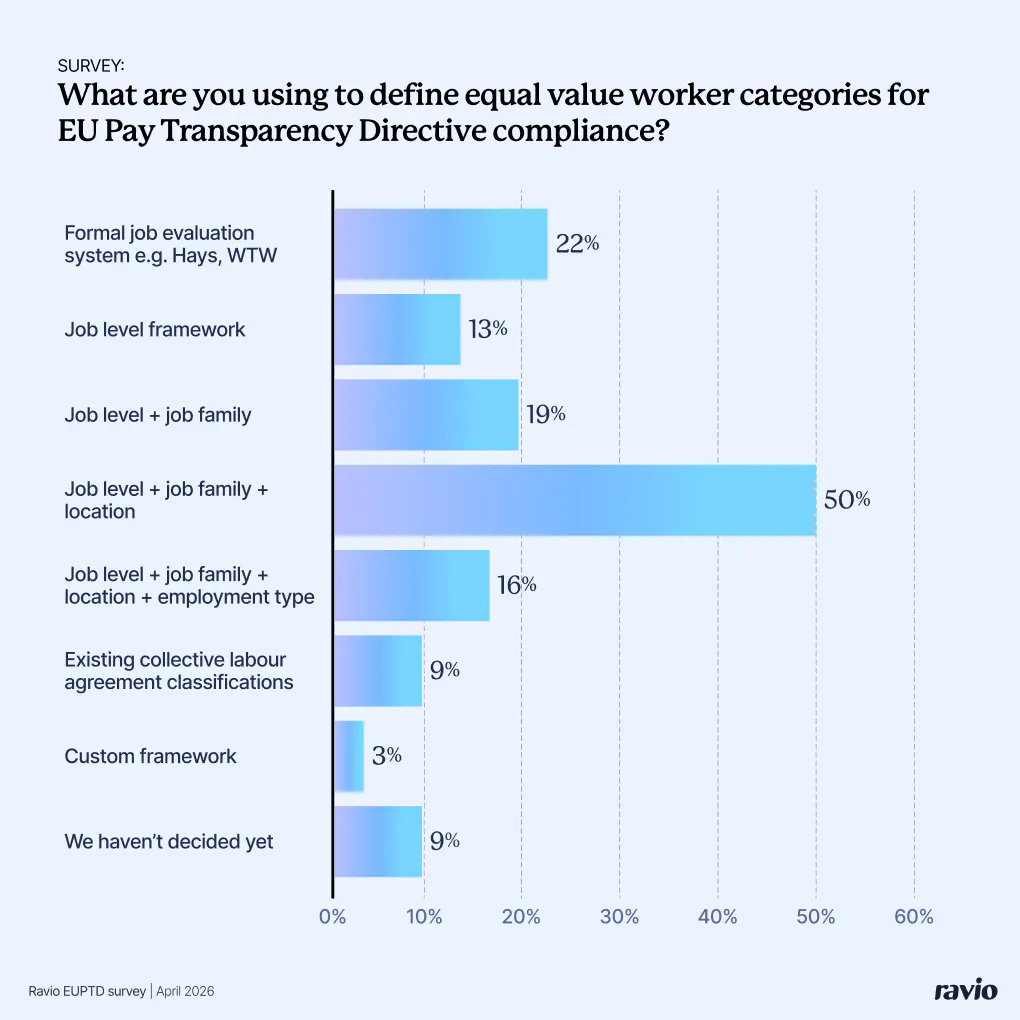
Companies are approaching this in fundamentally different ways. Ravio's survey found that only 22% are planning to use a formal job evaluation system.
The majority – 50% – are using existing job architecture (job level and job family) as their primary basis, sometimes combined with location or employment type. A further 25% cited difficulty deciding which dimensions to use as one of their top challenges.
Sofía Guijarro sees both approaches as potentially defensible but flags a specific risk for companies historically led by market benchmarks: "It's not a coincidence that market benchmarking isn't explicitly named as an objective justification in the Directive. The EU has long recognised that labour market structures are not always gender-neutral."
What to do:
What the Directive requires:
Employers must be able to justify pay differences between employees performing equal work or work of equal value using objective, gender-neutral criteria. Where a gap exists that cannot be justified, it must be fixed.
What's causing confusion:
Many companies have relied on market rates as the primary explanation for pay differences.
The Directive makes this position uncomfortable – market benchmarking isn't explicitly named as a valid justification, and legal cases are beginning to test this. Next’s equal pay ruling, for instance, found that they could not use talent scarcity to justify a pay difference when they could demonstrably afford to pay both groups equally.
Skills premiums present a particular challenge. If a premium has been applied to a role – AI expertise being the current example – that creates a pay difference that will need justification in future reporting cycles, when the premium may no longer apply or when other employees have acquired the same skill.
What to do:
What the Directive requires:
Gender pay gap reporting must cover all components of pay – base salary, variable pay, equity, and benefits – broken down by worker category. The Directive's definition of "pay" is broad: it includes bonuses, overtime, travel allowances, meal vouchers, occupational pensions, and compensation for attending training.
What's causing confusion:
Pulling together data from disparate payroll, pension, and benefits systems into a consistent format is operationally complex. 22% of Reward Leaders in Ravio's survey cited difficulty getting clean, consistent data from their HR systems as a top preparation challenge.
What to do:
What the Directive requires:
Employers with 150 or more employees must submit their first gender pay gap report in June 2027, covering calendar year 2026. That data collection is already underway.
What's causing confusion:
Reporting must be broken down by category of workers performing equal value work – not just as a single company-wide figure. This means the categorisation work in area 1 above must be resolved before the reporting infrastructure can be built. Companies that haven't settled their approach to equal value categories cannot meaningfully start building their reporting system.
The uncertainty around national transposition is also creating inertia. People and Reward teams report are being expected to have answers they don't yet have, while some leadership teams are deprioritising preparation on the basis that most countries haven't yet transposed – with some even happy to take non-compliance fines rather than prioritise the work.
What to do:
Dive deeper: Anita Lettink answers EUPTD's hardest questions
This tracker is current as of 13th August 2026.
Only four of 27 EU member states met the 7 June 2026 transposition deadline: Slovakia, Italy, Lithuania, and Malta.
The remaining 23 are at various stages of drafting or have not yet begun. We will continue to update this tracker as national laws are passed.
Country | Transposition status |
|---|---|
🇮🇹 Italy | Fully transposed |
🇱🇹 Lithuania | Fully transposed |
🇸🇰 Slovakia | Fully transposed |
🇲🇹 Malta | Fully transposed |
🇬🇷 Greece | Fully transposed |
🇵🇱 Poland | Partial transposition |
🇧🇪 Belgium | Partial transposition |
🇨🇿 Czech Republic | Partial transposition |
🇪🇪 Estonia | Partial transposition; remainder on pause |
🇦🇹 Austria | Draft published |
🇧🇬 Bulgaria | Draft published – in public consultation |
🇨🇾 Cyprus | Draft published |
🇩🇰 Denmark | Draft published – targeting Jan 2027 implementation |
🇫🇮 Finland | Draft published, submitted to partliament |
🇫🇷 France | Draft published – parliamentary debate expected end of 2026 |
🇮🇪 Ireland | Draft published – adoption delayed |
🇱🇻 Latvia | Draft published |
🇳🇱 Netherlands | Draft published – targeting Jan 2027 implementation |
🇷🇴 Romania | Draft published |
🇪🇸 Spain | Draft published, in public consultation |
🇵🇹 Portugal | Draft published, in public consultation |
🇸🇪 Sweden | Draft published – adoption delayed due to request for EU renegotiation |
🇩🇪 Germany | Expert commission recommendations published – no draft bill |
🇭🇷 Croatia | No announced steps |
🇭🇺 Hungary | No announced steps |
🇱🇺 Luxembourg | No announced steps |
🇸🇮 Slovenia | No announced steps |
🇳🇴 Norway | Will be bound by the Directive after it enters EEA agreement (12-24 months after EU deadline) |
🇮🇸 Iceland | Will be bound by the Directive after it enters EEA agreement (12-24 months after EU deadline) |
🇱🇮 Liechtenstein | Will be bound by the Directive after it enters EEA agreement (12-24 months after EU deadline) |
Legislation: Legislative Decree No. 96 of 7 May 2026, published in the Gazzetta Ufficiale on 1 June 2026, in force 7 June 2026.
What it contains:
Italy's law transposes all core Directive requirements covering pay transparency in recruitment, employee right to pay information, gender pay gap reporting, joint pay assessments, burden of proof, and anti-retaliation protections.
National variations from the Directive:
Enforcement and penalties:
What this means for employers with employees in Italy:
Legislation: Law No. XV-969, adopted by the Seimas on 21 May 2026, in force 7 June 2026. Implementing regulations from the Minister of Social Security and Labour followed on 17 July 2026, in force 31 July 2026.
What it contains:
Lithuania transposed via amendments to the Labour Code, covering all core Directive requirements: pay transparency in recruitment, employee right to pay information, gender pay gap reporting, joint pay assessments, and burden of proof.
A phased implementation approach was adopted – most provisions came into force on 7 June 2026, but more complex obligations are deferred to 2027 and 2028. The July implementing order fills in the operational detail the original law left open, fixing the exact dates on which right-to-information and Sodra reporting duties activate.
National variations from the Directive:
Enforcement and penalties:
What this means for employers with employees in Lithuania:
Legislation: Law No. 76/2026 Z. z. (Equal Pay Act), approved by the National Council on 15 April 2026, signed by the President on 23 April 2026, published in the Collection of Laws on 8 May 2026, in force 7 June 2026.
What it contains:
Slovakia's Equal Pay Act is a minimal transposition – close to the Directive's baseline with added procedural clarity, stronger worker protections, and concrete enforcement mechanisms. It was the first EU member state to fully transpose.
National variations from the Directive:
Enforcement and penalties:
What this means for employers with employees in Slovakia:
Legislation: Legal Notice 173 of 2026 – the Equal Pay (Transparency and Reporting) Regulations, 2026 – published 5 June 2026, in force 7 June 2026. Made under the Employment and Industrial Relations Act (Cap. 452).
What it contains:
Malta's regulations transpose all core Directive requirements, applying immediately to all public and private sector employers with no transitional period.
National variations from the Directive:
Enforcement and penalties:
What this means for employers with employees in Malta:
Legislation: Law 5316/2026, voted by the Hellenic Parliament on 2 July 2026, published in the Government Gazette (ΦΕΚ Α' 105) on 6 July 2026. Greece is the fifth EU member state to complete transposition, and the first in southern Europe to do so.
What it contains:
The law transposes the Directive by amending the Greek Labour Code. It entered into force on publication, but the substantive pay transparency obligations – recruitment transparency, the right to pay information, gender pay gap reporting, joint pay assessments, remedies, and anti-retaliation protections – are deferred to 1 November 2026.
National variations from the Directive:
Enforcement and penalties:
What this means for employers with employees in Greece:
Legislation: Right-to-information provisions and salary range transparency in recruitment already in force via partial transposition. A further draft bill covering the remaining obligations – pay gap reporting, employee right to information, and enforcement – was published 29 April 2026, with a delayed entry into force confirmed at six months after official publication.
What is currently in force:
The December 2025 Act transposes Article 5 of the Directive – recruitment-stage transparency only. All of the following apply to all Polish employers regardless of size, from 24 December 2025:
What remains pending – draft bill published April 2026:
The second bill covers all remaining Directive obligations.
Key variations from the Directive's baseline:
What this means for employers with employees in Poland:
Legislation: No federal legislation in force for private sector employers, with partial public sector transposition only. The federal government requested a six-month extension from the European Commission in May 2026; the Commission declined. The Fédération Wallonie-Bruxelles decree (September 2024) and the Flemish Parliament decree (June 2026) are the only legislation currently in force, both limited to their respective public sectors.
What is currently in force:
Fédération Wallonie-Bruxelles (French Community public sector): Decree of 12 September 2024, in force 1 January 2025. Applies to all organisations under the Federation's authority – public entities, educational institutions, and government administrations.
Key obligations:
Flemish Region (Flemish public sector):
Federal level (private sector):
What this means for employers with employees in Belgium:
Legislation: Two measures already in force as partial early transposition. A full draft transposition bill was published by the Ministry of Labour and Social Affairs on 26 March 2026, targeting 1 January 2027 implementation, with first pay gap reports expected from 2028.
What is currently in force:
The Czech Republic has enacted two standalone obligations ahead of full transposition, both already applying to all employers:
What remains pending – draft bill published March 2026:
Full transposition via Labour Code amendment is still in draft, targeting 1 January 2027. The draft takes a self-described "minimalist" approach – closely mirroring the Directive's baseline.
Key variations from the Directive's baseline:
What this means for employers with employees in Czech Republic:
Legislation: Amendments to the Employment Contracts Act, adopted by the Riigikogu on 17 June 2026, approved by the President on 29 June 2026, in force 13 July 2026.
What's currently in force:
Estonia has transposed a limited slice of the Directive on recruitment-stage transparency only:
Gender pay gap reporting, the employee right to request comparative pay information, and mandatory pay structures are not yet transposed.
Estonia requested a two-year postponement from the European Commission on 16 April 2026, which the Commission has not granted. The remainder of transposition is currently paused and not moving through the legislative process.
National variations from the Directive:
Enforcement and penalties:
What this means for employers with employees in Estonia:
Legislation: Draft submitted by the Labour Minister on 6 June 2026 for political coordination within the coalition government. Not yet entered formal parliamentary process.
What it contains:
The draft broadly mirrors the Directive's requirements on pay transparency in recruitment, employee information rights, and gender pay gap reporting. It also introduces a requirement for employers to carry out regular pay analyses.
National variations from the Directive:
What this means for employers with employees in Austria:
Legislation: Draft transposition bill published 19 May 2026, public consultation closed 18 June 2026. Amends the Protection against Discrimination Act and Labour Code. No confirmed effective date.
What it contains:
The draft broadly follows the Directive's requirements on pay transparency in recruitment, employee information rights, and gender pay gap reporting.
What this means for employers with employees in Bulgaria:
Legislation: Draft bill published November 2025. Full title: "The Strengthening of the Implementation of the Principle of Equal Remuneration between Men and Women for Equal Work or Work of Equal Value, through Wage Transparency and Enforcement Mechanisms Law of 2026." Finalisation pending.
What it contains:
A largely clean transposition of all core Directive requirements, with several areas going beyond the minimum.
National variations from the Directive:
Enforcement and penalties:
What this means for employers with employees in Cyprus:
Legislation: Draft bill published by the Ministry of Employment on 26 February 2026, public consultation closed 27 March 2026. Implementation targeted 1 January 2027. First pay gap reports due September 2028.
What it contains:
The draft largely mirrors the Directive on pay transparency in recruitment, employee information rights, pay gap reporting, and joint pay assessment triggers. Implemented via amendments to the Danish Equal Pay Act (Ligelønsloven).
National variations from the Directive:
Enforcement and penalties:
What this means for employers with employees in Denmark:
Legislation: Government bill HE 129/2026, submitted to the Finnish Parliament on 9 July 2026, following the working group draft from May 2025 and the government proposal published in December 2025. Targeted entry into force is 1 January 2027.
What it contains:
Closely follows the Directive's minimum requirements, implemented via amendments to the Act on Equality Between Women and Men (Tasa-arvolaki), rather than a standalone law.
National variations from the Directive:
Enforcement and penalties:
What this means for employers with employees in Finland:
Legislation: Preliminary draft transposition bill published 6 March 2026, circulated to social partners for consultation 19 March 2026, and submitted to the Conseil d'État on 7 June 2026 as a 22-article text covering both the private sector and the civil service.
As of late June 2026, the Ministry of Labour indicated parliamentary debate would run through the second half of 2026, with a vote now expected in early 2027 – not by the end of 2026 as originally signalled.
What it contains:
France's transposition will be significantly more demanding than the Directive's minimum in several areas.
National variations from the draft:
Enforcement and penalties:
What this means for employers with employees in France:
Legislation: Draft transposition bill published, focused primarily on pre-employment transparency requirements. Pay gap reporting provisions will require separate legislation.
The Pay Transparency Bill remains listed on the government's Summer 2026 Legislative Programme but, as with the Spring 2026 programme before it, was not given priority drafting status.
What it contains:
Pre-employment obligations including salary range disclosure and a ban on salary history questions.
National variations from the draft:
Enforcement and penalties:
What this means for employers with employees in Ireland:
Legislation: Draft transposition bill published for public consultation, closed 9 April 2026. Passed to the Cabinet of Ministers, then to the Saeima for consideration.
What it contains:
A standalone Pay Transparency Law (not an amendment to existing legislation). Latvia's draft broadly follows the Directive's requirements but contains several notable variations.
National variations from the Directive:
What this means for employers with employees in Latvia:
Legislation: Netherlands announced on 15 September 2025 that timely implementation was not feasible and set 1 January 2027 as its target.
An updated draft was published in June 2026 following consultation feedback. A draft ministerial regulation on gender pay gap reporting, together with a draft reporting form, template, and data specification, followed on 9 July 2026, open for consultation until 11 September 2026. This sits alongside the separate draft Order in Council (Algemene maatregel van bestuur, or AMvB), which elaborates the bill's core provisions and closed its own consultation on 31 July 2026.
What it contains:
Broadly follows the Directive's requirements.
National variations from the draft:
Enforcement and penalties:
What this means for employers with employees in the Netherlands:
Legislation: Draft law published by the Ministry of Labour, Family, Youth and Social Solidarity on 30 March 2026, public consultation closed 8 April 2026. A revised draft was published the same day incorporating earlier stakeholder feedback. The collapse of the Romanian government in May 2026 has created significant uncertainty about when the bill will progress through parliament.
National variations from the draft:
Enforcement and penalties:
What this means for employers with employees in Romania:
Legislation: Draft Real Decreto amending Real Decreto 902/2020 (Spain's existing pay equality framework), published for public consultation (audiencia pública) on 3 August 2026 by the Ministry of Labour and Social Economy. Consultation closes 24 August 2026. The government is using the Real Decreto route – bypassing full parliamentary passage – to move faster after missing the June deadline.
What it contains:
A partial transposition built on Spain's existing framework of the registro retributivo (pay register) and the auditoría retributiva (pay audit), rather than a standalone law.
National variations from the Directive:
Enforcement and penalties:
What this means for employers with employees in Spain:
Legislation: Draft proposta de lei amending Lei n.º 60/2018 (Portugal's existing pay equality law), published 5 August 2026 in Separata n.º 26 of the Boletim do Trabalho e Emprego. Public consultation runs until 25 August 2026. The government has confirmed this draft is a partial transposition.
What it contains:
Portugal builds on its existing Balanço das Diferenças Remuneratórias (pay gap assessment), calculated centrally using the Relatório Único – the annual payroll dataset already submitted by all employers. This gives Portugal an authority-led reporting model: the state combines employer-submitted data with its own administrative records to produce the gender pay gap figures, rather than each employer calculating its own indicators.
Notable national variations from the Directive and decisions made:
Enforcement and penalties:
What this means for employers with employees in Portugal:
Legislation: On 26 March 2026, the Swedish government announced it does not intend to submit a transposition bill to the Riksdag and is instead seeking both a postponement of the Directive's implementation deadline and a renegotiation of the Directive at EU level. Sweden is the only EU member state to have formally paused transposition.
Background:
Sweden originally voted against the Directive in 2023. In January 2026 it referred a draft bill to the Council on Legislation for implementation on 1 July 2026, then in March 2026 delayed that to 1 January 2027, then on 26 March announced the process was paused entirely.
The government's position is that the Directive is too administratively burdensome, offers insufficient flexibility for Sweden's collective bargaining model, and risks undermining the gender equality outcomes it is meant to advance.
Sweden already requires employers with 10 or more employees to conduct annual equal pay surveys (lönekartläggning) under the Discrimination Act – these remain in force.
What this means for employers with employees in Sweden:
Legislation: No formal draft bill published.
An expert commission appointed by the Federal Ministry for Family Affairs (Bundesministerium für Familie, Senioren, Frauen und Jugend) submitted its recommendations on EUPTD transposition in November 2025.
The responsible ministry has since confirmed that legislation will not enter into force before early 2027 at the earliest, and that pay gap reporting duties and the individual right to pay information will not become effective until June 2028.
What the recommendations contain:
The commission proposed a "bureaucracy-reduced" model that will inform the forthcoming draft bill.
Key positions are:
What this means for employers with employees in Germany:
The following countries have announced no steps toward transposition as of July 2026 and have no published draft legislation. No obligations are in force under the Directive. Existing national anti-discrimination and equal pay laws continue to apply in each country.
The EU Pay Transparency Directive applies to EU member states only.
However, Norway, Iceland, and Liechtenstein participate in the European Economic Area (EEA) and will be bound by the Directive once it is formally incorporated into the EEA Agreement.
The EU Pay Transparency Directive has been in force since 7 June 2026. Individual EU member states were required to transpose it into national law by that date. Only four of the 27 member states – Slovakia, Italy, Lithuania, and Malta – met the deadline. National transposition is still in progress across most markets. See Ravio’s transposition tracker above for country-by-country status.
Yes, if you employ people in EU member states. The Directive applies based on where your employees are located, not where your company is registered. UK-headquartered companies with 100 or more EU-based employees are subject to the reporting obligations for those employees.
Yes. The Directive is EU law from 7 June 2026 regardless of whether your country has passed national legislation. In countries that have transposed, obligations are immediately enforceable. In countries that haven't, the Directive's requirements apply in principle, national courts are expected to interpret existing law in line with it, and public sector employers may be directly bound. Don't wait for national legislation to begin preparation.
Pay covers base salary plus any benefit payable directly or indirectly in cash or in kind – including bonuses, variable pay, overtime, travel allowances, meal vouchers, and occupational pensions. The definition is deliberately wide to prevent employers from hiding pay gaps in non-salary components.
Generally no – the Directive applies to workers with an employment contract or employment relationship. However, the boundary is less clear than it appears. Platform workers, on-demand workers, and trainees may fall within scope depending on the facts of the working relationship. If you have significant contractor populations, take legal advice on whether they fall within scope.
According to the timing of the Directive, for employers with 150 or more employees: June 2027, covering 2026 calendar year data – meaning data collection is already underway. For employers with 100–149 employees: June 2031.
But, note that some member states have set different deadlines in their national laws – Slovakia requires reports by 15 April, Denmark by September 2028. Check your country's specific transposition in Ravio’s tracker above.
No – the Directive doesn't mandate a specific methodology. However, your approach to defining equal value worker categories must be objective, gender-neutral, and defensible. Most companies are using existing job architecture (job level and job family) as their basis. The EIGE job evaluation toolkit is the reference standard that trade unions and enforcement bodies are likely to use, so aligning with it reduces risk. See Anita Lettink's guidance here.
Not on their own. The Directive does not list market benchmarking as a valid objective justification for pay differences. Valid criteria include documented skills and qualifications, effort, working conditions, responsibility, and performance measured through a transparent, gender-neutral framework. Market data can inform pay decisions but cannot be the sole rationale for a gap between employees doing work of equal value.
The unadjusted gap is the raw difference in average pay between men and women across the organisation – it reflects both pay discrimination and occupational segregation. The adjusted gap controls for role, level, and location, showing whether men and women doing equivalent work are actually paid equivalently. The adjusted gap is the more meaningful measure for identifying systemic discrimination, and the one most likely to expose compliance risk.
A joint pay assessment is triggered when a gender pay gap above 5% is identified in any worker category and the employer cannot objectively justify it. But it doesn't happen immediately – the Directive sets up a three-step process: first, the employer must justify the gap; if they can't, they have six months to correct it; only if it remains unjustified after that point does a formal joint pay assessment with worker representatives become mandatory.
The employer. Where an employee brings a pay discrimination claim, the employer must demonstrate that pay differences are based on objective, gender-neutral criteria. This burden of proof shift also applies where an employer has failed to meet its transparency or reporting obligations – non-compliance with the Directive creates a presumption of discrimination that the employer must rebut.
The two areas where software makes the biggest difference are building the foundational pay structures the Directive requires, and running the pay equity analysis that reporting obligations demand.
Ravio supports both. The salary bands tool lets you build and maintain structured compensation bands by role, level, and location – and apply your equal value worker groupings directly within the band structure, so your categorisation approach is reflected in how pay data is organised and analysed. The pay equity module then runs analysis across those groupings, surfacing gender pay gaps by category and identifying where differences can and can't be objectively justified. See how Ravio helps you find and eradicate pay gaps.
Your monthly dose of market insights and expert perspectives
Women make up 36% of the European tech workforce in 2026, but just 22% of executives and 25% of top earners. See the latest women in tech statistics.

The gender pay gap in European tech is 20% unadjusted and 1% adjusted in 2026. See the gap by country, function, and level – and what's driving it.

How is the gender pay gap calculated? Step-by-step median and mean formulas with a worked example, the adjusted vs unadjusted gap explained, and what the EU Directive requires.

