
Pay equity
Women in tech statistics 2026: the representation gap driving pay inequity
Women make up 36% of the European tech workforce in 2026, but just 22% of executives and 25% of top earners. See the latest women in tech statistics.


First published: 25 September 2023
Last updated: 4 November 2026
Why is understanding your company’s gender pay gap important?
Well, systemic differences in pay between men and women contribute to overall gender inequality.
Which means companies have a key role to play in eliminating gender inequality in society as a whole, through addressing bias and discrimination in compensation.
That’s the big picture view.
On top of that, there’s also:
So, all in all, the gender pay gap is a pretty important compensation metric.
But how should you go about calculating it?
Quick answers: gender pay gap calculations
The gender pay gap is a measure of the difference between typical earnings for men and women, given as a percentage.
It can be calculated as a median gender pay gap, with the calculation:
(median salary for men – median salary for women) / median salary for men x 100
Or a mean gender pay gap with the calculation:
(mean salary for men – mean salary for women) / mean salary for men x 100
At Ravio, we use the median gender pay gap as standard within our compensation benchmarking platform, because the median is less prone to outliers.
However, legislative reporting typically requires both the mean and median gender pay gap to be calculated (e.g. UK gender pay gap reporting, EU Pay Transparency Directive).
Say a small team has five men and four women, with these annual salaries:
Step 1: Find the median for each group. The median salary for men is the middle value, £60,000. With an even number of women, the median is the average of the two middle values: (£45,000 + £55,000) ÷ 2 = £50,000.
Step 2: Calculate the median gap. (£60,000 – £50,000) ÷ £60,000 × 100 = 16.7%.
Step 3: Find the mean for each group. Men: £350,000 ÷ 5 = £70,000. Women: £208,000 ÷ 4 = £52,000.
Step 4: Calculate the mean gap. (£70,000 – £52,000) ÷ £70,000 × 100 = 25.7%.
The mean gap is much bigger because of the single £120,000 salary – which is exactly why the median is often a better measure of the typical gap, and why reporting usually asks for both.
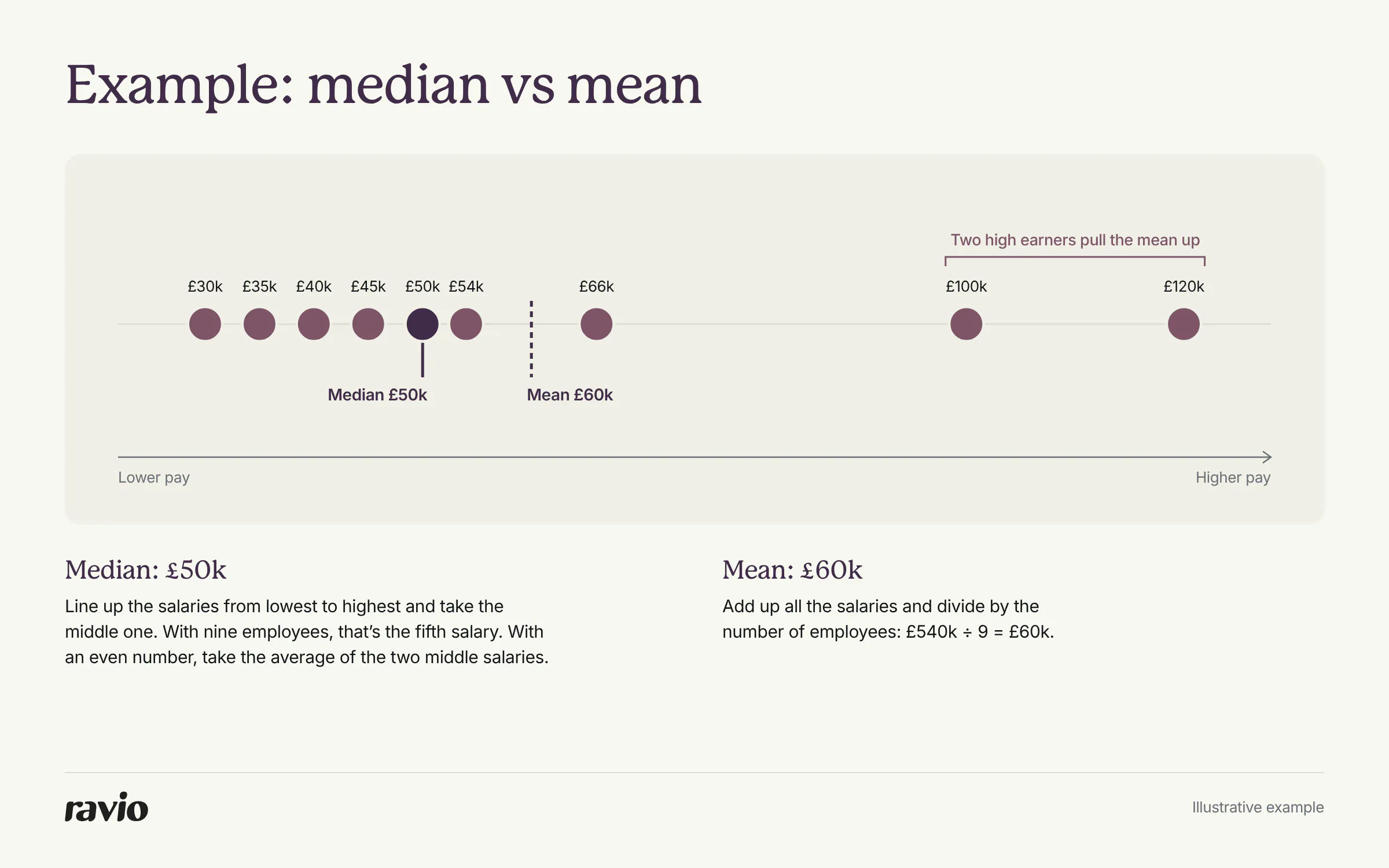
Looking at both together tells you more than either on its own.
As well as the median and mean, there is a second distinction in how the gender pay gap is calculated: unadjusted and adjusted.
What’s the difference between the unadjusted and adjusted gender pay gap?
The unadjusted gender pay gap gives a view of the raw difference in pay between all men and women – this is the figure given by the calculations shown above.
The adjusted gender pay gap takes into account other systemic factors which contribute to pay differences between men and women who do equal work – such as job role and responsibilities, education level, work experience – by ‘adjusting’ the raw data to account for these things, typically by running a regression analysis on the unadjusted pay gap data to understand how one variable relates to another.
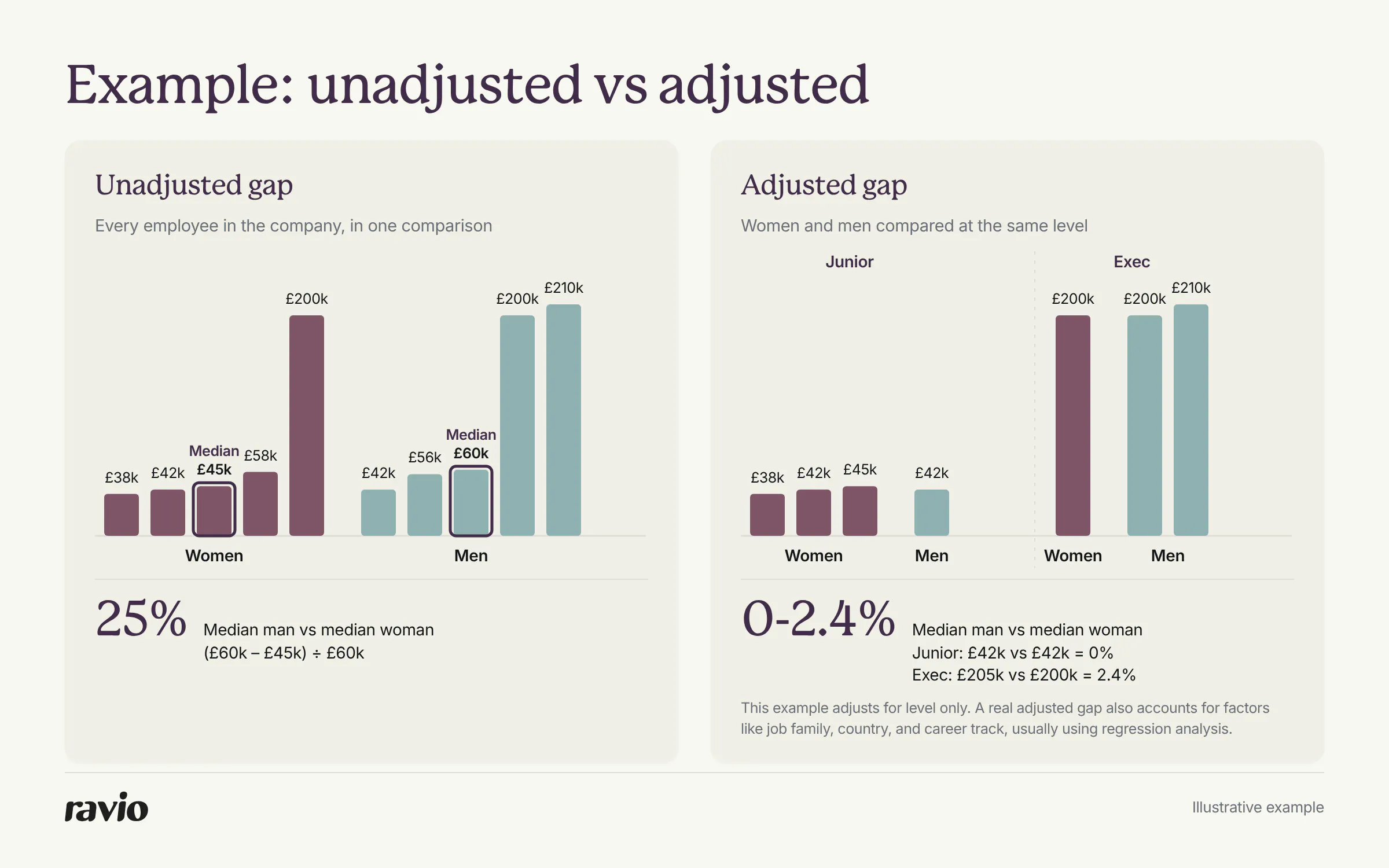
In Ravio's data, for example, the adjusted gap accounts for country, job family, seniority level, and career track – so it compares women and men doing like-for-like work at the same company.
Because there are so many factors which impact pay discrimination towards women, the adjusted gender pay gap can be a more valuable metric to help companies identify where pay discrepancies are coming from, and so what actions should be taken to rectify this.
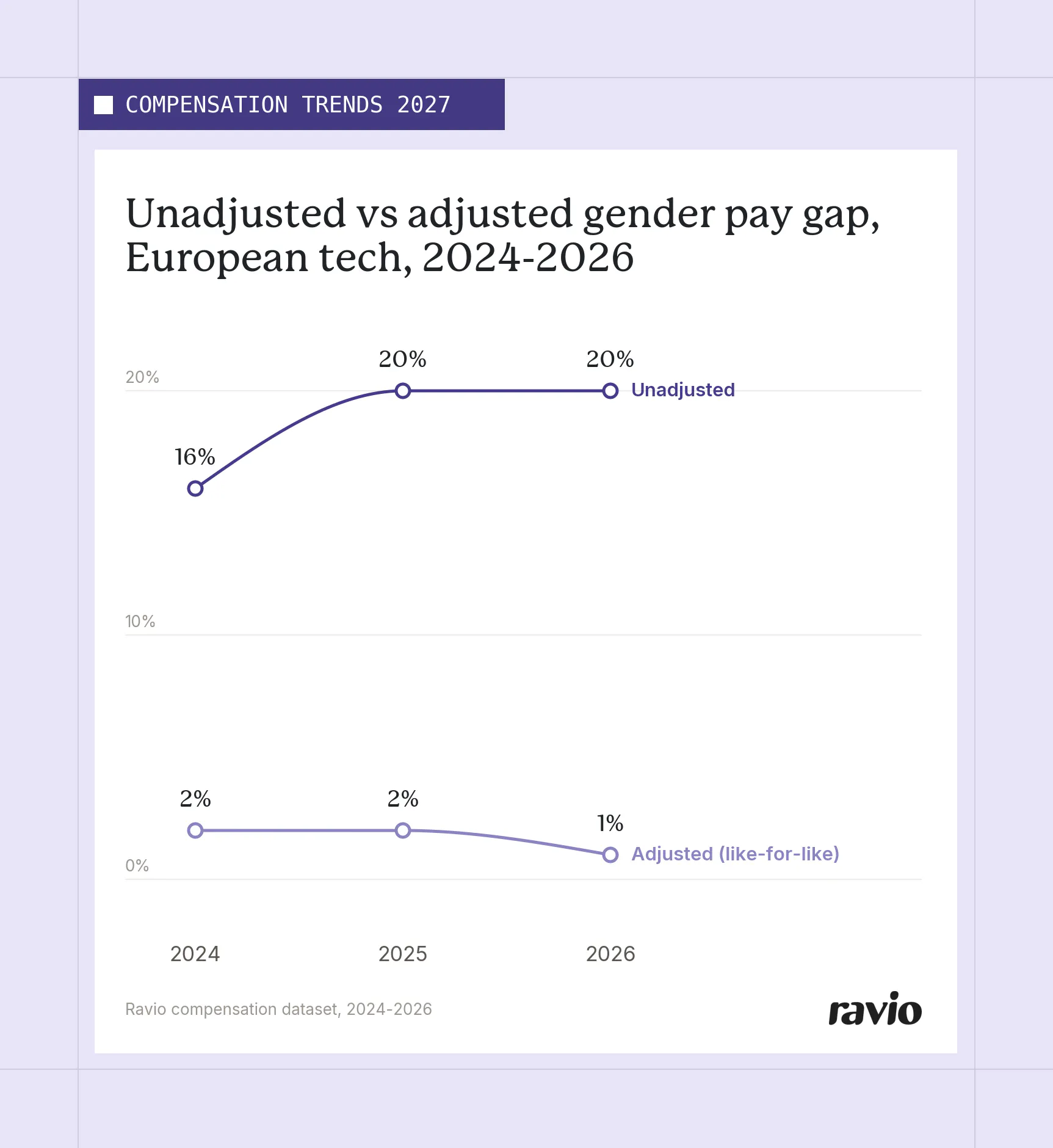
The gap between your unadjusted and adjusted figures tells you what's driving pay inequality.
European tech is a clear example of the first pattern.
In 2026, the unadjusted gender pay gap is 20%, but the adjusted gap is just 1% (source: Ravio Compensation Trends 2027) – most of the gap comes from where women sit in the workforce, not unequal pay for the same role.
European tech | 2024 | 2025 | 2026 |
|---|---|---|---|
Unadjusted gender pay gap | 16% | 20% | 20% |
Adjusted gender pay gap | 2% | 2% | 1% |
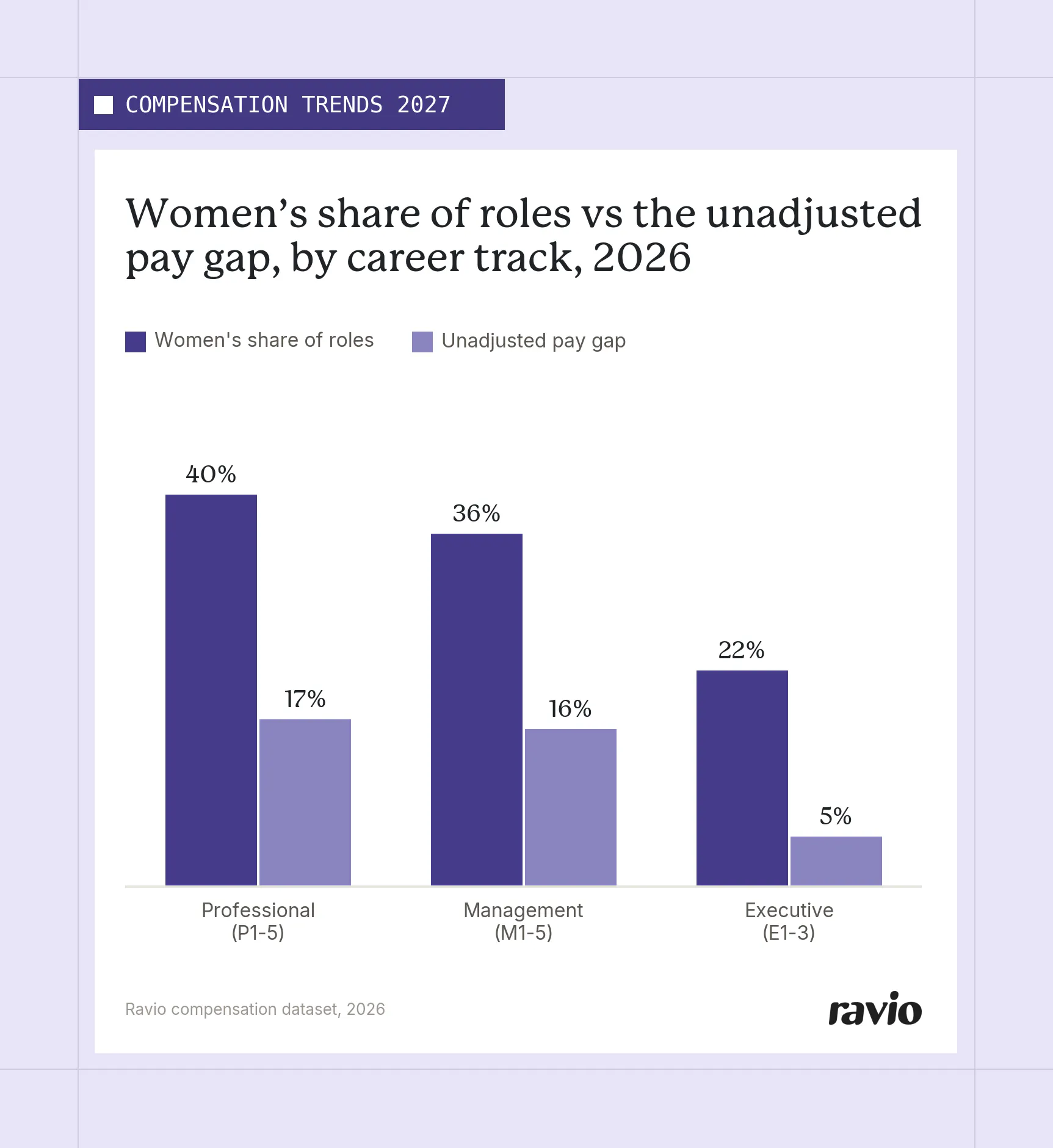
For instance, Ravio’s data shows that only 22% of executive level employees in European tech are women, compared to 78% of these roles which are held by men (Ravio Compensation Trends 2027).
But, if we looked only at the gender pay gap in executive roles we’d see that it’s just 3% at this level – which is why representation is such an important additional piece to monitor and address when looking at improving gender diversity in your company.
The EU Pay Transparency Directive requires employers with 100+ employees to report on:
If the gap in any category of workers is 5% or more, can't be justified by objective, gender-neutral factors, and isn't fixed within six months, employers must carry out a joint pay assessment with worker representatives.
Reporting starts with companies of 250+ employees, with smaller companies phased in over the following years – and exact requirements depend on how each country transposes the Directive.
In the UK, employers with 250+ employees must report six measures each year: the mean and median gender pay gap in hourly pay, the mean and median bonus gap, the proportion of men and women receiving a bonus, and the proportion of men and women in each pay quartile.
Calculate your gender pay gap automatically
Ravio's pay equity analysis software calculates your adjusted and unadjusted gaps, pay quartiles, and gaps by worker category – plus our new EU Pay Transparency module gets you ready for equal value category reporting.
The gender pay gap is calculated by subtracting women's median (or mean) pay from men's median (or mean) pay, dividing by men's median (or mean) pay, and multiplying by 100. For example, if the median man earns £60,000 and the median woman earns £50,000, the median gender pay gap is 16.7%.
The adjusted gender pay gap measures the difference in pay between men and women doing comparable work, after accounting for factors like job role, seniority, and location – usually using regression analysis. In European tech, the adjusted gap is 1% in 2026, compared with a 20% unadjusted gap (Ravio Compensation Trends 2027).
The unadjusted pay gap compares all men and all women, regardless of role or level. The adjusted pay gap compares men and women doing similar work. A large unadjusted gap with a small adjusted gap points to a representation problem; a large adjusted gap points to unequal pay for equal work.
For a quick unadjusted gap, you can use the formula above in a spreadsheet: (men's median pay – women's median pay) ÷ men's median pay × 100. Calculating an adjusted gap, or reporting by worker category for the EU Pay Transparency Directive, needs regression analysis and clean job architecture data – which pay equity software like Ravio can do automatically.
Use both. The median is a better measure of the typical gap because it isn't skewed by outliers, while the mean shows the impact of very high earners. Both are required for UK and EU Pay Transparency Directive reporting.
Your monthly dose of market insights and expert perspectives
Women make up 36% of the European tech workforce in 2026, but just 22% of executives and 25% of top earners. See the latest women in tech statistics.

The gender pay gap in European tech is 20% unadjusted and 1% adjusted in 2026. See the gap by country, function, and level – and what's driving it.

A complete guide to pay transparency in France: current law, what the EU Directive changes, how France's draft transposition bill goes further, and how to prepare for compliance.

