Every company wants to hire and retain exceptional talent. But how competitively do you actually need to pay to make that happen?
The conventional wisdom is clear: lead the market with pay at the 75th percentile and beyond, and you'll win the talent war – great employees will choose you over competitors, stay longer, and perform better, helping the business achieve its goals.
But market-leading salaries come with significant costs: payroll expenditure, more pressure on runway, and questions about long-term financial sustainability.
So is a lead-the-market pay strategy actually worth it?
To investigate, we analysed employee departure data from Ravio's compensation database, tracking retention patterns across different base salary target percentiles. The findings reveal that the relationship is far more nuanced than most companies realise – and where you invest in competitive salaries matters just as much as how those salaries are.
The case for (and against) a lead-the-market pay strategy
A lead-the-market pay strategy means positioning your employee salaries above the market median – typically targeting the 75th percentile or higher.
It’s an approach that top tech players like Netflix use to compete aggressively for the best possible talent, but that doesn’t mean it’s the right approach for every company.
Benefits of market-leading salaries:
- Hire top talent more easily. With compensation a leading decision-making factor for job candidates, market-leading salaries give you a significant advantage – especially in competitive hiring markets like tech.
- Improve retention and reduce employee turnover. Retention is consistently cited as the primary benefit of market-leading pay, with employees paid above market less likely to leave because of more attractive offers elsewhere (more on whether this market-leading pay actually impacts retention in the next section).
- Strengthen your employer brand. Companies known for paying competitively build reputations as employers of choice, creating a virtuous cycle where top performers want to work alongside other top performers.
Drawbacks and risks of market-leading salaries:
- High labour costs. Paying at the 75th percentile versus the 50th means significantly higher payroll costs. For a 100-person company, that's potentially hundreds of thousands in additional annual expenditure.
- Financial sustainability. If your financial situation changes, pulling back from a market-leading position can be extremely difficult – employees accustomed to premium compensation may leave if their pay stagnates, creating exactly the retention problem you were trying to avoid.
- Risk of 'golden handcuffs'. High salaries can keep employees in roles even when they're no longer engaged or aligned with the work, impacting culture, innovation, and long-term performance.
- Market positioning requires constant attention. To truly lead the market, you need reliable, up-to-date compensation benchmarks and regular salary band refreshes. Without this data and infrastructure, you may think you're leading the market when you've actually fallen behind.
Analysis: Does market-leading pay actually improve employee retention?
The ability to retain great employees is seen as one of the top benefits of a lead-the-market pay strategy – with compensation a key reason that employees choose to move roles, market-leading salaries reduce the risk of them looking elsewhere for financial reasons.
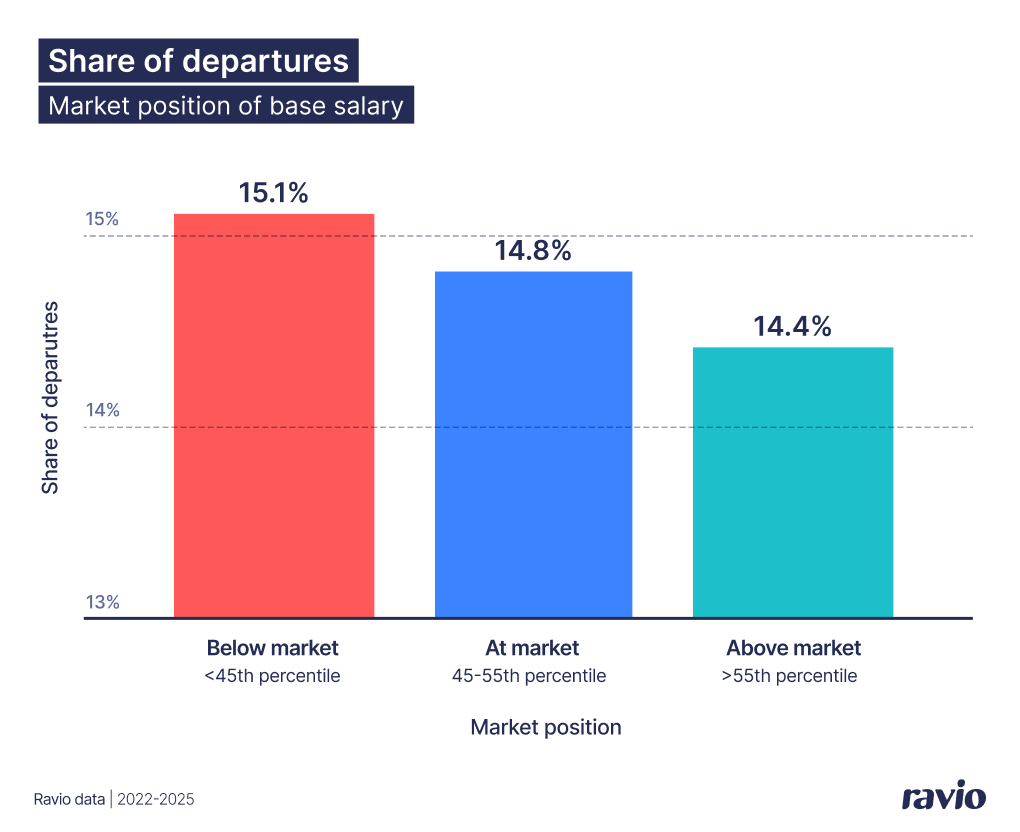
We analysed the share of employee departures in Ravio’s compensation database across three pay groups: below market (<45th percentile), at market (45-55th percentile), and above market (>55th percentile).
The headline finding? Yes, market-leading pay does improve employee retention.
Employees with market-leading (>55th percentile) have the lowest share of departures at 14% of employees, whilst employees with below market (market lagging) salaries have the highest share of departures (15%) – so there is a statistically significant link between paying above market and employee retention.
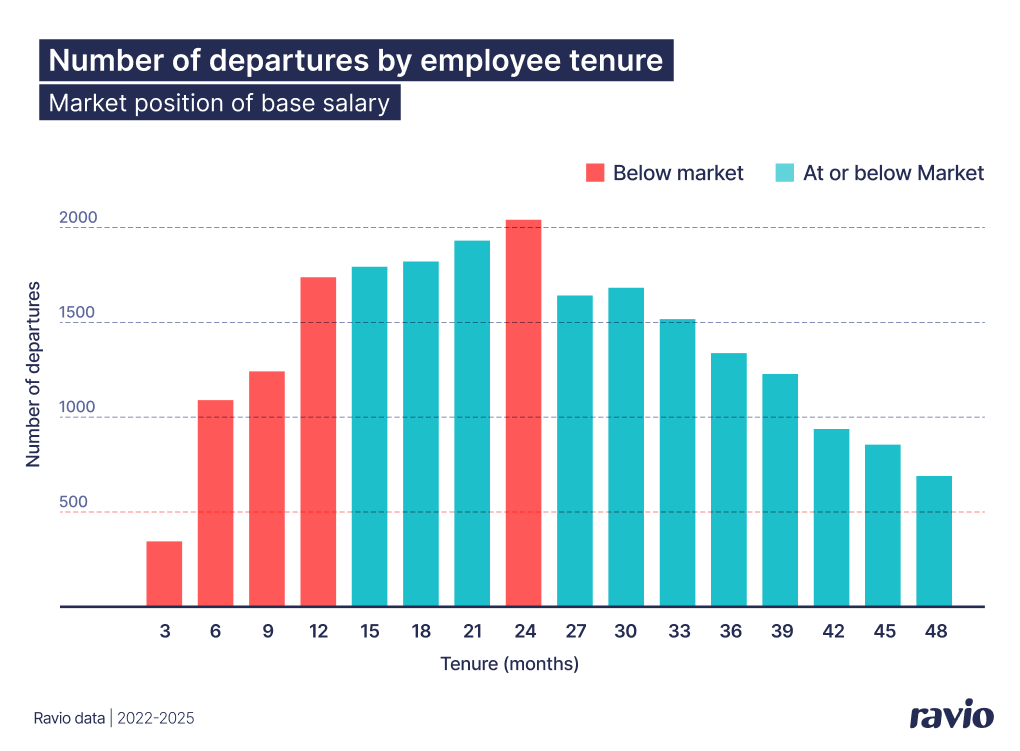
Then we looked at departure timing too.
We can also see that employees who leave their roles early (0-12 months) predominantly have market lagging salaries (<45th percentile). This suggests that below-market pay presents immediate retention risk and heightened turnover for new hires.
However, the retention impact of market-leading pay isn’t uniform across all roles
Whilst overall market-leading pay does improve employee retention, the impact isn’t the same across-the-board.
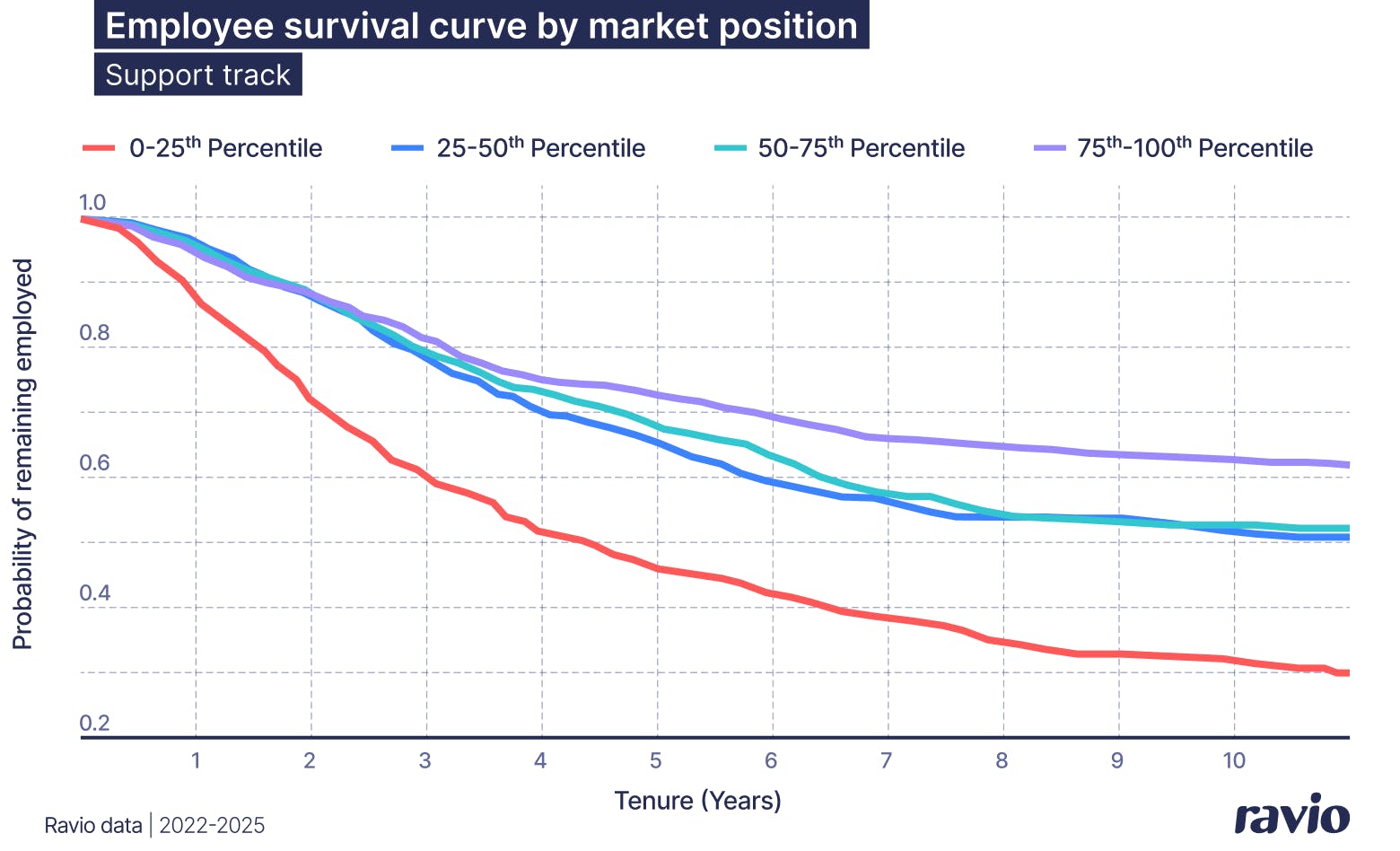
For instance, when we break down the analysis by exploring employee tenure lengths via survival analysis (modelling the probability of an employee remaining at a company over time) per career track, we can see that the pattern isn’t consistent:
- Support career track: Shows a particularly significant pattern of market-leading pay improving retention. If we take employees who reach 4 years of tenure as an example (see below graph), those paid in the 0-25th percentile have only a ~55% probability of reaching that tenure, compared to ~75% for those in the 75th-100th percentile.
- Professional career track: The pattern is strong for early career professionals (P1 and P2 levels) where market-lagging salaries lead to shorter tenures. However, there is no difference in tenure length based on target percentiles from P3 onwards.
- Management career track: No difference in employee tenure lengths based on the target percentile of salary.
So, whilst market-leading salaries do increase retention for Support and early-career Professionals, it makes no difference for established Professionals or Managers.
Perhaps other factors, like equity compensation, career progression opportunities, or strategic influence, matter more than base salary positioning for senior talent.
So, whilst market-leading salaries do increase retention for Support and early-career Professionals, it makes no difference for established Professionals or Managers.
Perhaps other factors, like equity compensation, career progression opportunities, or strategic influence, matter more than base salary positioning for senior talent.
"Competitive salaries are more powerful for retention than ever. Employees know well-paying roles are scarce, and the risks of switching – new probation periods, less stable companies – make staying put more attractive. My advice: identify your top 20% of critical roles where rehiring would be toughest, and invest your above-market pay there. Be strategic rather than trying to pay everyone premium rates."

HR Consultant and Strategic Advisor
How to decide if a lead-the-market pay strategy is right for your company
Market-leading pay isn't a one-size-fits-all solution. The right approach depends on your company's strategic priorities, financial position, and what you're trying to achieve with compensation.
Start with your compensation philosophy and business needs
Before deciding on a target percentile, get clear on the 'why' behind your approach.
Matt McFarlane, Director at FNDN, calls this being "market-informed" rather than market-driven: "The company's philosophy on compensation and their financial position are equally important inputs as the market data, but I see so many startups skip that step and head straight to the data. The most effective approach is a marriage between market data and company context."
He particularly emphasises the importance of grounding compensation decisions in your specific business reality: "I always spend a lot of time deeply understanding the mission, the culture, the kinds of people that are going to help deliver on it, and the current situation from a financial perspective.
“You want your compensation decisions to be strategic – these are the calibre of people we need to hire to hit key milestones based on our business model, it will cost us this, and it will have this impact on our P&L."
Ask yourself:
- What are your organisation’s core beliefs about pay? For example: do you believe employees should never need to worry about compensation? If so, market-leading pay might make complete sense from a company values and culture perspective.
- What are your business priorities? Are you executing a rapid growth plan that requires aggressive hiring? Building a high-performance culture where only exceptional talent will succeed? Competing against well-funded rivals for scarce expertise?
- Which roles are genuinely business-critical? Our analysis shows market-leading pay improves retention for Support and early-career Professional roles, but makes little difference for Management or senior ICs. Where would leading the market actually create value for you? Which roles are you struggling to hire or retain for? Which roles is it vital to fill quickly to deliver on goals?
"Every company should identify their own business-critical roles and pay them at P60 or P75. The days of paying everyone at median are over – that's a recipe for losing your key talent. Whether it's engineering at a tech startup or operations at a logistics company, invest in the roles that drive your success."

Senior Compensation Manager at Bolt and Co-founder of Cohorts
💡 Examples: Companies using lead-the-market pay strategies
- Ravio. We pay competitively to attract and retain the talent we need to grow, but we also factor in financial sustainability to ensure we are a responsible employer with longevity in mind. We also target a higher percentile for Technical roles than for Commercial, to reflect the highly competitive market for tech talent.
- Netflix. Offers "personal top of market" salaries (typically 90th percentile+) because their entire culture is built around hiring exceptional performers who are expected to deliver results.
- Buffer. Targets the 70th-90th percentile and benchmarks all roles against San Francisco salaries (known for being among the highest in tech), making their compensation particularly competitive. This approach stems from their core philosophy around fair and transparent pay – where 'generous' compensation is a fundamental principle that ensures employees are paid well above market average, building trust and accountability across their fully remote team.
Then evaluate your financial reality
Can you truly afford 15-25% higher payroll costs compared to market median? More importantly, can you sustain that positioning if growth slows or funding becomes tighter?
Market-leading pay is easier to implement than maintain – so getting realistic on payroll costs, and considering whether it actually makes sense long-term, is key.
Don’t forget to consider your broader total rewards strategy
Leading the market on base salary doesn't mean neglecting other total compensation levers.
In fact, many competitive employers combine market-leading pay with other market-leading elements e.g. quite compensation or benefits – Buffer, for instance, combines market-leading salaries with highly desirable employee benefits like fully remote working and a 4-day working week.
Consider how you can differentiate through:
- Benefits packages – can strengthen retention without the ongoing cost of higher salaries
- Flexible working arrangements – increasingly important to employees, lower cost to implement
- Equity compensation – giving employees an ownership stake can also be incredibly powerful for motivation and retention
- Career development opportunities – clear progression paths and taking the time to understand what individual employees actually want to grow and develop. This might mean lateral moves, funding new skills, or creating stretch projects – not just salary increases and upward promotions.
How to implement and maintain a lead-the-market pay strategy
If you decide it’s right for your company, implementing a lead-the-market approach requires careful planning and ongoing commitment. Here are the key steps:
1. Get reliable market data across all percentiles
You can't lead the market if you don't know where the market actually is – and getting the data is a vital first step to understand the true implications for ongoing payroll costs.
Access to reliable compensation benchmarks is an absolute must, and the provider you use needs to:
- Provide current market benchmarks – look for providers like Ravio that gather compensation data via live HRIS integrations and refresh the resulting benchmarks, rather than those that use a point-in-time salary survey process.
- Surface the target percentiles you need for each role e.g. 75th or 90th percentile, not just market medians.
2. Define your compensation philosophy first
Articulate why market-leading pay makes sense for your organisation:
- Who are you competing against for talent?
- Why do you believe market-leading pay will lead to business success?
- Will you lead the market on base salary alone, or combine it with equity, benefits, and bonuses?
- Will every role, location, and level have the same target percentile, or is the market-leading approach more important for some than others?
3. Build pay structures that reflect your strategy
Building structured salary bands – rather than making one-off pay decisions – is critical for consistency whatever your chosen pay strategy is.
So, once you’ve defined that strategy, reflect it in your salary band structure through aligning band midpoints with your chosen target percentiles.
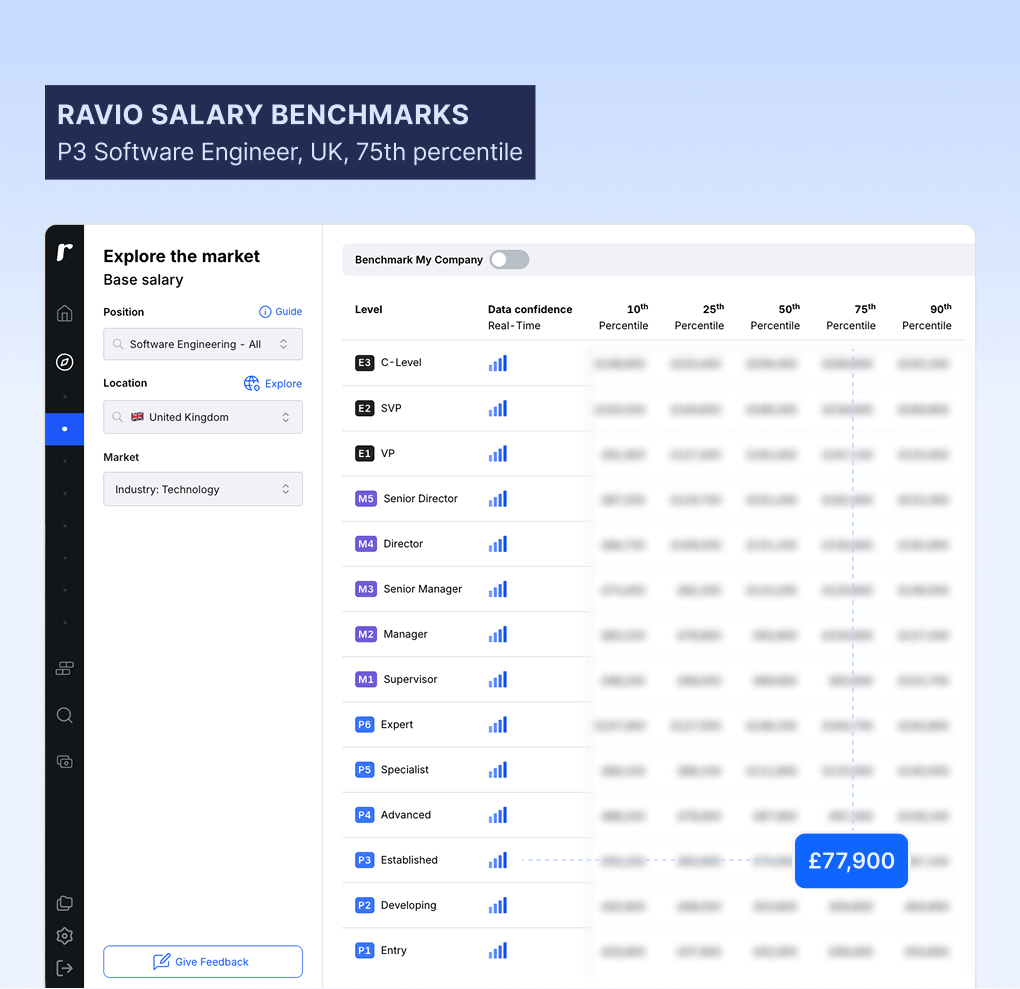
For example, if you're targeting the 75th percentile for your Software Engineering function then £77,900 becomes your band midpoint for your P3 Software Engineers in the UK (as per Ravio benchmarking data, November 2025).
If you already have a salary band structure and you’re moving to a lead-the-market pay strategy, you’ll also need to decide how to bring existing employees in-line – will you immediately make salary adjustments to ensure everyone is paid at the new target percentile, or will that be a phased process over time e.g. during the next two compensation reviews?
4. Communicate transparently
Explaining your compensation philosophy and how salaries are determined to all employees is, perhaps, the most important part of setting a pay strategy – especially if motivation and retention are core aims.
When people understand how their pay is decided, that it's competitive (highly competitive, in the case of a lead-the-market strategy) and fair, and that this will be maintained over time through regular compensation reviews, it builds trust and reduces anxiety.
If you're transitioning to market-leading pay from a previous approach, it’s important to be clear about why this is happening, the timeline, and what employees can expect – this is something employees will inevitably be very invested in.
5. Build processes to maintain your market-leading position over time
Leading the market today doesn't mean you'll lead it in 12 months.
Talent and compensation markets move constantly, and without regular maintenance, your "market-leading" salaries can quickly become average.
The key pieces to build into your systems and processes are:
- Use real-time benchmarking data. Traditional salary surveys are outdated by the time they're published. Instead, use real-time salary benchmarking tools that connect directly to companies' HRIS systems, with salary data updated continuously to reflect live pay changes, and benchmarks refreshed regularly. Some providers, like Ravio, also offer additional market trends data, tracking changing demand for certain roles or skills to help you stay ahead of market shifts.
- Refresh your bands regularly. Review and update salary bands at least annually (ideally more frequently) to reflect current market conditions – most companies will refresh their bands as a first step during compensation reviews. Using a salary band tool like Ravio’s that enables you to refresh bands instantly against up-to-date benchmarks is a huge timesaver for companies with a lead-the-market pay strategy.
- Make market adjustments proactively. Once bands are refreshed, it’s vital to then make any market adjustment raises needed to ensure employees retain the same band position if the market has shifted for their role – so that employees don’t start to fall behind the market, impacting motivation and retention.
FAQs
What is a lead-the-market pay strategy?
A lead-the-market pay strategy positions employee salaries above the market median – typically targeting the 75th percentile or higher. Companies using this approach aim to attract and retain top talent by paying more competitively than most of their talent competitors.
What is a lag-the-market pay strategy?
A lag-the-market pay strategy means paying below market median (50th percentile). Companies using this approach often offset lower base salaries with other compensation elements like generous equity grants, exceptional benefits, mission-driven work, or strong career development opportunities.
What is market-leading pay?
Market-leading pay means compensation positioned above the 50th percentile of market benchmarks, making you more competitive than 50% of companies hiring for similar roles.
What makes companies choose a lead-the-market pay strategy?
Companies typically choose market-leading pay strategies when:
- They're competing for talent in a highly competitive market
- They want to reduce time-to-hire or reduce the risk of attrition – across the entire organisation, or for certain roles or functions
- Their culture centres on hiring exceptional performers who deliver outsized impact
- They have the financial runway to sustain premium compensation over time.
What is the relationship between compensation and retention?
According to Ravio's retention analysis, employees with market-leading (>55th percentile) have the lowest share of departures at 14% of employees, whilst employees with below market (market lagging) salaries have the highest share of departures (15%) – so, broadly, higher compensation improves employee retention.
The compensation-retention link is strongest for Support functions and early-career Professional roles (P1-P2), but diminishes for Senior Individual Contributors (P3+) and Management roles, where other factors like career development and strategic influence may matter more than base salary positioning.