



Market trendsBenchmarking
The AI compensation and talent trends shaping the job market in 2026
AI compensation and hiring trends: 88% growth in AI hiring, 12% salary premiums, and how demand for AI skills is reshaping the tech talent market.

Maximising employee tenure is a core goal for most HR and Reward teams. Longer tenure means lower recruitment costs, stronger institutional knowledge, more productive teams.
But to improve average employee tenure effectively, you need benchmarks.
What does 'typical' job tenure look like in tech? How does your company compare? And what trends should inform your retention strategy?
In this guide, we'll break down the latest employee tenure data and explore how tenure has shifted over the past three years.
Employee tenure (also called job tenure) is the length of time an employee works in a role – the same job position at the same company.
It's an important metric for HR and Reward teams because longer tenure directly impacts business performance:
The average employee tenure in 2025 is 2 years and 1 month (Ravio 2026 Compensation Trends report).
This is calculated using Ravio’s compensation dataset, looking at the median time employees stay in a job across the European tech industry.
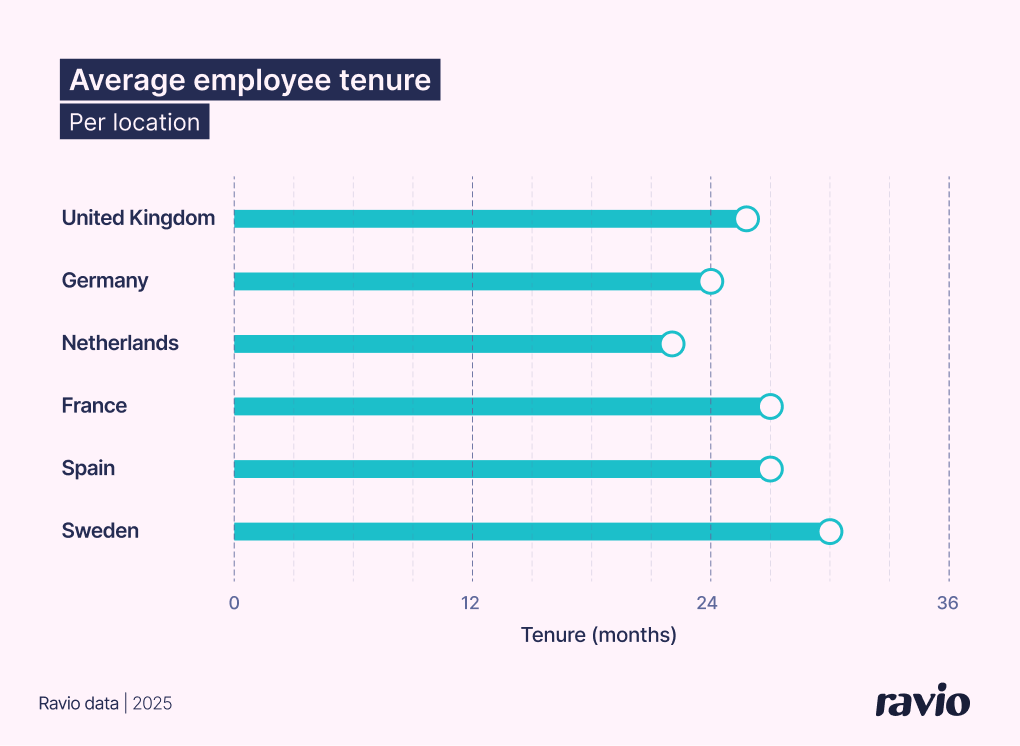
Average job tenure in most European markets clusters around 2 years to 2 years 3 months tenure, close to the overall average of 2 years and 1 month:
Two markets stand out as exceptions:
Sweden has the longest average employee tenure at 2 years 6 months – interesting given their spike in attrition this year (+28%), suggesting this results more from recent departures rather than chronic turnover issues.
The Netherlands has the shortest tenure at 1 year 10 months despite currently low attrition rates (14% this year, 12% last year). This suggests the Dutch market may have experienced higher turnover in previous years that continues to impact average tenure figures.
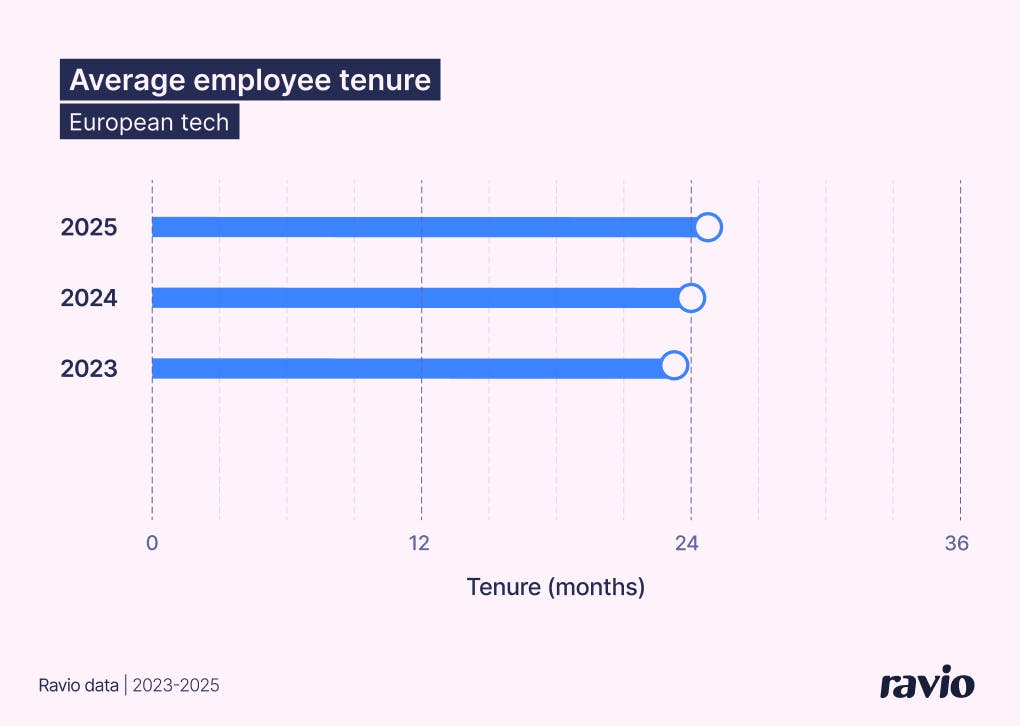
Average employee tenure has increased steadily over the past three years, gradually lengthening from 1 year 9 months in 2023 to 2 years in 2024, and now 2 years 1 month in 2025.
This consistent upward trend reflects the stabilising job market. With hiring rates declining and economic uncertainty driving a focus on job security, employees are staying in roles longer rather than seeking new opportunities.
Year-on-year changes:
Whilst the rate of increase has slowed in 2025, the direction remains clear – employees are settling into longer tenures across the board.
Average employee tenure has increased substantially across most job functions, in line with the overall trend, with some roles seeing particularly sharp jumps:
These 20%+ increases in just one year demonstrate a significant shift in employee job mobility. The combination of uncertain job markets and post-layoff risk aversion has created an environment where employees are choosing stability over movement.
"Marketing's 27% tenure increase tells an interesting story. Marketing roles are often one of the first to face cuts, but are also first to be rehired given their revenue impact. Marketing talent learned they're vulnerable during downturns, so they're staying put now they have stability. Smart companies will be investing to retain these business-crucial roles while they can."

HR Consultant and Strategic Advisor
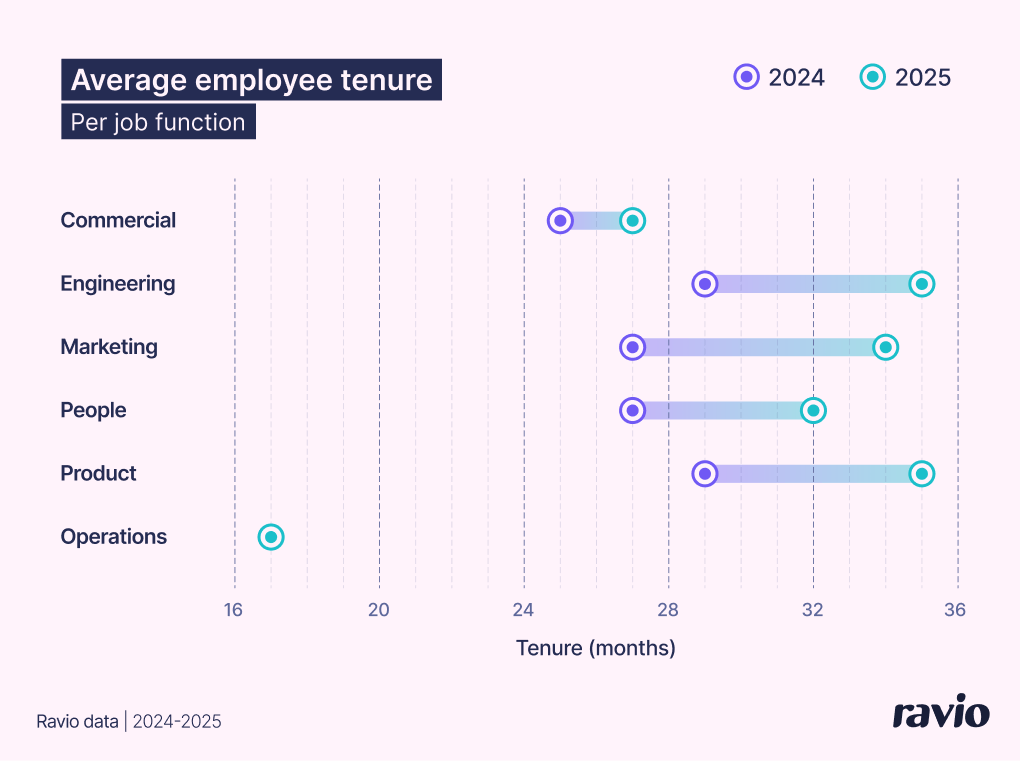
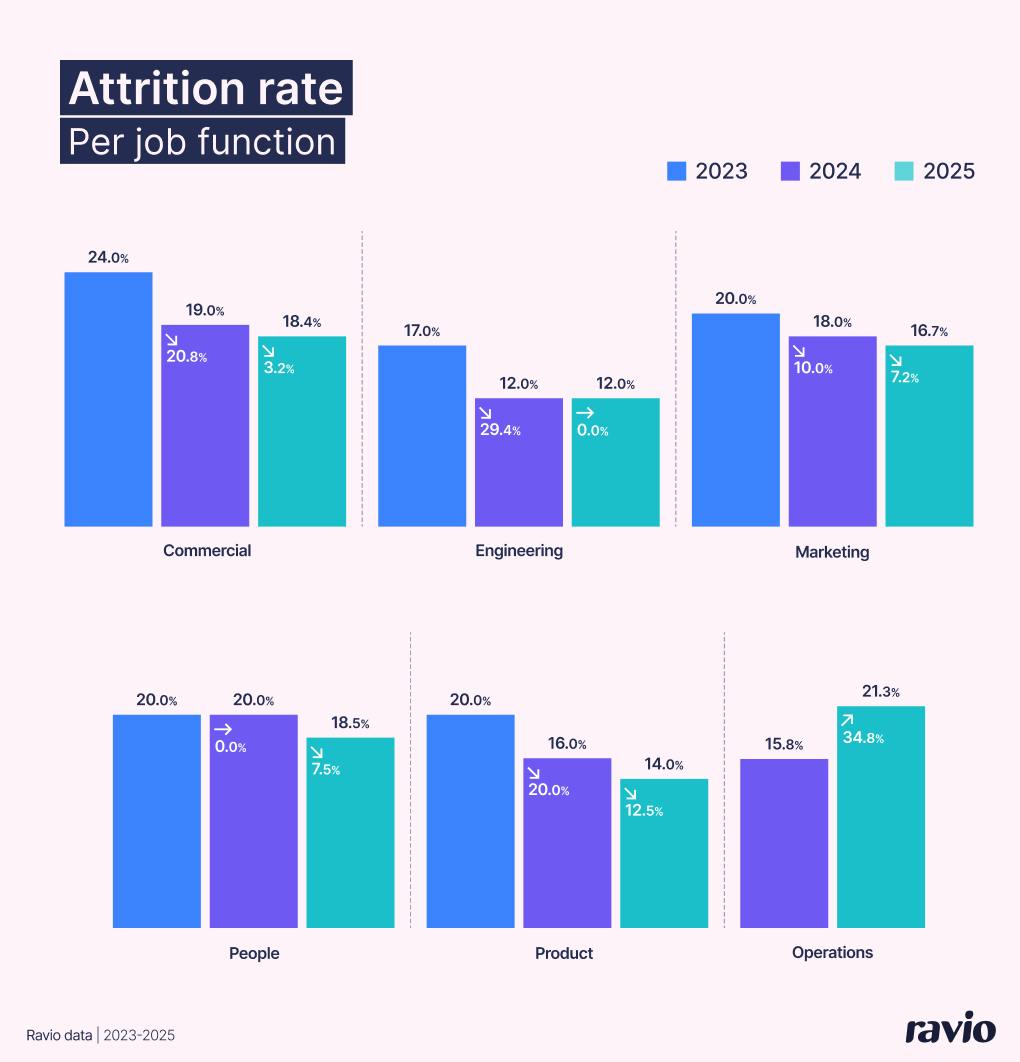
Operations stands as the exception with tenure of just 1 year 5 months – less than half that of other functions. This mirrors the 34.8% surge in attrition also seen in Operations roles, reinforcing the instability in this function.
Whether through automation, outsourcing, or strategic restructuring as AI transforms routine tasks, Operations clearly represents a function in flux.
"The shift we're seeing in Operations is very real. As AI engineers pick up workflow automation, data handling, and even parts of customer support, the traditional Ops role is being redefined. Companies are experimenting with leaner Ops teams, and these compensation trends reflect that uncertainty."

Talent and Portfolio Development Partner at Northzone
Understanding average tenure benchmarks provides important context, but what can you actually do to increase employee tenure and reduce turnover costs at your company?
Based on insights from Ravio's network of Reward Leaders, here are five proven strategies for improving job tenure:
Competitive compensation is crucial for retention.
In fact, Ravio's 2026 Compensation Trends report includes an analysis on the link between market-leading salaries and employee retention, which found that employees paid above market (>55th percentile) stay longer and are less likely to leave in their first year.
"Every company should identify their own business-critical roles and pay them at P60 or P75. The days of paying everyone at median are over – that's a recipe for losing your key talent. Whether it's engineering at a tech startup or operations at a logistics company, invest in the roles that drive your success."

Senior Compensation Manager at Bolt and Co-founder of Cohorts
Competitive base salary matters, but relying solely on salary means you're limited by budget and the need to ensure fair pay across the team.
Look at other levers across your Total Rewards offering:
"The current economic environment is putting enormous pressure on HR and People leaders, who are being challenged to do even more with less. With budgets limited, there's an increasing need to use non-cash incentives like equity and benefits to help retain and motivate their best people."

Chief People Officer at Ravio
Even the most competitive compensation strategy fails if employees don't understand it.
When compensation decisions feel opaque or arbitrary, employees assume favouritism or bias – eroding trust and driving them to look elsewhere.
Help employees understand how decisions are made: target percentiles, market benchmarks, the role of performance. Share your compensation philosophy during onboarding to set expectations early. Explain your approach to salary reviews in all-hands meetings so everyone hears the same message – and don’t forget manager enablement to ensure they’re able to have effective 1:1 pay conversations too.
Career progression and promotion paths are consistently a top challenge in retaining employees – they need to understand not just where they are today, but where they can go and how to get there.
That means ensuring:
"People find great comfort in clarity. A well-structured talent development plan gives them a clear vision of their future and what they need to work on to get there. It's crucial for HR and Reward managers to remember this and focus on developing these frameworks well."
Chief People Officer at Ravio
Employees who feel undervalued or uncertain about their performance are more likely to leave – regular recognition and feedback throughout the year builds the engagement and connection that drives retention.
Peer-to-peer recognition platforms, monthly awards, celebrating wins in team meetings, a kudos Slack channel – all help employees feel valued for their contributions year-round, not just during performance reviews.
Regular feedback from managers reinforces this. Weekly 1:1s, quick check-ins after milestones, or informal praise when someone does great work keeps employees informed about where they stand, avoiding employees feeling unappreciated or uncertain about their future.
Job tenure (also called employee tenure) is the length of time an employee has worked for the same company or in the same position. It's measured in months or years and is an important metric for HR teams tracking retention and workforce stability.
To calculate average employee tenure, add up the total tenure (in months or years) of all current employees, then divide by the total number of employees. This gives you the mean average.
Alternatively, median tenure (the midpoint value) can provide a more representative figure when you have outliers with very long or very short tenures. To calculate median tenure, arrange all employee tenures in order from shortest to longest, then find the middle value (or average the two middle values if you have an even number of employees).
For example: If you have 10 employees with tenures of 1, 1.5, 2, 2, 2.5, 3, 3, 4, 5, and 10 years, the average tenure is 3.4 years, but the median tenure is 2.75 years – reducing the impact of large outliers.
Median employee tenure is the midpoint value when all employee tenures are arranged in order from shortest to longest. Half of employees have been with the company longer than the median, and half have been there for less time. Median tenure is often more representative than average tenure because it's not skewed by a few employees with very long or very short tenures.
The average employee tenure in 2025 is 2 years and 1 month, according to Ravio's 2026 Compensation Trends Report. This represents a gradual increase from 2 years in 2024 and 1 year 9 months in 2023, reflecting the stabilising job market where employees are staying in roles longer.
The average employee tenure in the UK in 2025 is 2 years and 2 months, according to Ravio's 2026 Compensation Trends Report. This is slightly above the European average of 2 years and 1 month, and sits within the cluster of most European markets (UK, Germany, France, and Spain all range between 2 years and 2 years 3 months).
Whether 3 years is a good job tenure depends on your industry, role, and career stage. In European tech, the average employee tenure in 2025 is 2 years and 1 month (from Ravio’s 2026 Compensation Trends report), so 3 years would be above average and generally considered strong tenure.
Your monthly dose of market insights and expert perspectives
AI compensation and hiring trends: 88% growth in AI hiring, 12% salary premiums, and how demand for AI skills is reshaping the tech talent market.

European tech has stabilised after years of volatility – but AI and pay transparency mean new transformation. Nico Kaml, Karam Deo, Chloe Paramatti, and Evert Kraav unpack the latest compensation trends for 2026 planning.

The average promotion rate is 4.0%. Discover how promotion rates and salary increases vary across Europe, job functions, and company stages.