The best (and worst) tools for salary benchmarking
From free salary calculators to real-time benchmarking platforms, the options are wide – and the quality varies enormously. Here's every type of salary benchmarking tool compared for 2026.

An employee tells you they're moving from London to Madrid. Do you cut their salary to reflect Spanish market rates?
The answer can vary – it depends on whether the move is permanent, who initiated it, what your wider approach to location-based pay looks like, and what kind of precedent you want to set.
But what shouldn’t vary is the approach behind the answer. Because when relocation is handled on a case-by-case basis, you can easily end up with two employees who went through identical situations but end up with very different packages and experiences.
That inconsistency is hard to undo, and if you ever try to introduce a formal global mobility programme on top of it, you're building on shaky foundations.
This guide is for the Reward leader who wants a consistent, defensible approach to designing employee relocation packages.
We cover approaches to adjusting salaries, what allowances and support to include in the relocation package, and how to handle the difficult conversations that come with moves – with input throughout from two experts in the topic: Amanda Moore and Liam Bax-Branagan.
A relocation package is the financial and practical support a company provides to help an employee move location for work.
It might include salary adjustments, a one-off or ongoing allowance to support with the costs of relocation, and any additional support with the move such as advice on immigration law or a buddy in the new location.
There are two typical scenarios for employee relocations:
Both scenarios should be guided by the same underlying framework. The exact package might differ depending on context, but the principles behind the decision should be consistent across the organisation.
The steps below work through everything you need to design a relocation package – from building the overall framework to designing an individual package to handling the difficult conversations.
As Amanda Moore, Senior Director of Reward, Performance and Analytics at Beyond One, explains: “The danger comes very quickly when your case-by-case approach to relocation packages becomes the norm.”
"Before you know it, you've got two people that have moved with exactly the same situation but have been treated differently,” she explains, “with no justifiable reason for that difference.”
To avoid case-by-case situations, design a framework for making relocation package decisions.
Liam Bax-Branagan, Head of People Operations and Compensation at European Energy, frames this as a way of preloading leadership decisions.
"If everything is within that framework, then we don't have to go to them every time a new relocation case comes up,” he says. “Leadership has already made those decisions – which means clearer guardrails, consistent treatment, and less time on individual cases."
The foundation of your approach to relocation is your compensation philosophy.
Do you already pay employees based on their working location? Is relocation vital to business goals (a global expansion, for instance)? Do your benefits packages reflect a belief in greater workplace flexibility or remote-working culture? That’s all important context to guide how you think about relocation packages.
Beyond that, the framework needs to include clear segmentation – there are so many variables in employee relocation that need to be reflected to enable consistent decision-making.
The variables that matter the most in determining levels of support are:
The framework needs to factor these variables in, to make it easy to decide which tier of support applies when a case arrives.
Liam is clear that you don’t need to try and anticipate every single potential scenario upfront. “Don't be afraid to create your frameworks with what you know at the moment,” he says.
“Define your core principles and outline the most common scenarios. Then, if an edge case comes in, use the principles to determine your approach, and decide if it’s a scenario worth documenting within the policy for future.”
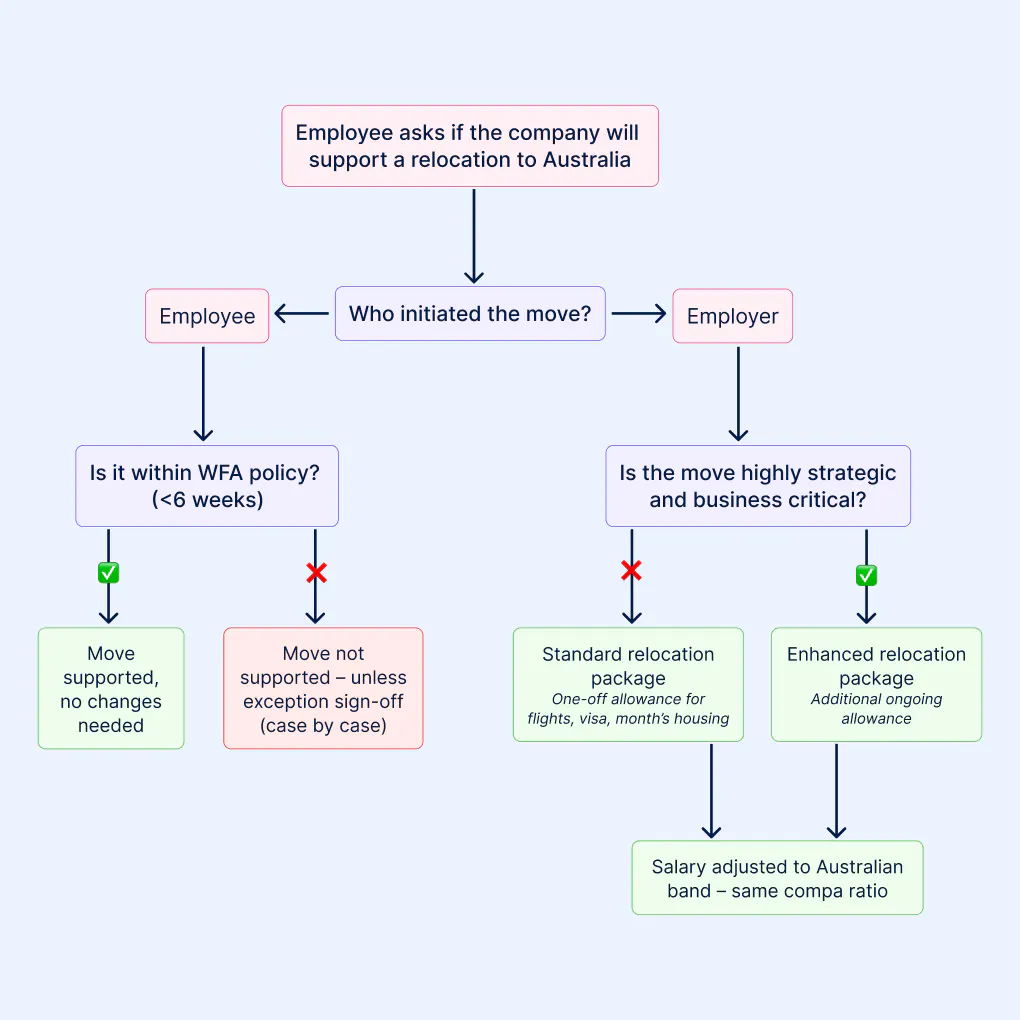
Take a scaling company with a location-based compensation approach and a three-days-a-week in-office model in an office based in London.
New roles are open to candidates anywhere, but require relocation if outside of a commutable distance to the London office – and the company supports that move as part of the offer because they value in-office collaboration.
The company does want to support flexibility, so has a 6-week work-from-anywhere policy as part of employee benefits, but permanent moves outside of that aren't typically supported.
Their relocation framework might look like this:

The framework tells you how to categorise a move. Before you do anything else with a specific case, understand why it's happening.
"The ‘why’ of the move is a really big driver in how it should be treated," explains Liam.
"Is this something where the employee themselves wants to move – maybe they've got some family circumstances – and you're accommodating that because it's part of your talent strategy? Or is it more: we have this really big new strategic location that we need to kick off, and we have this one person we trust to get that going?"
That distinction maps directly to the segmentation in your framework – an employer-initiated, business-critical move might justify stepping outside your standard relocation package. An employee-initiated move probably doesn't.
Beyond the why, Amanda points to a few other questions worth answering before any decisions are made.
"We always looked at what is happening to the individual and their wider family as well," she says. "Is home still continuing in the home location? Is it a short-term move or a medium-term move? Or are they actually going permanently – their whole life, their whole family – and wrapping up their home location?"
“I also like to speak to somebody who’s made the same or similar relocation before,” Amanda says. “We can create the philosophy and the framework, but the real-life experience can be very different, so we want to make sure we really understand the context first.”
The answer depends on your compensation philosophy – which, if you've followed Step 1, is already built into your framework.
If you take a location-agnostic approach and pay all employees on a single global scale regardless of where they work, relocation doesn't change anything.
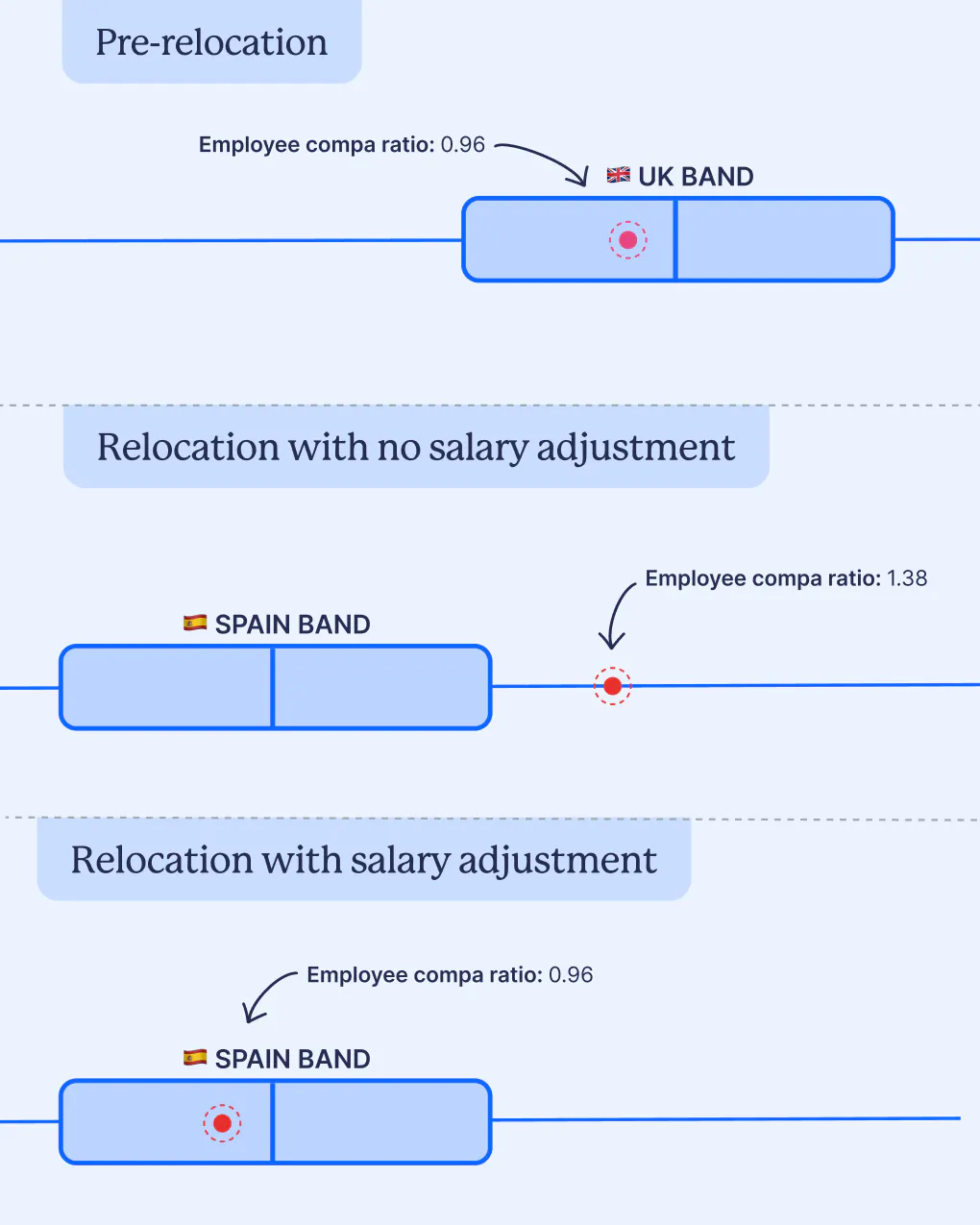
If you take a location-based approach and pay employees according to the market rates of their working location, then a move should trigger a salary adjustment to reflect the new location – whether based on market rates in that new location, or the differentials/location multiplier you use.
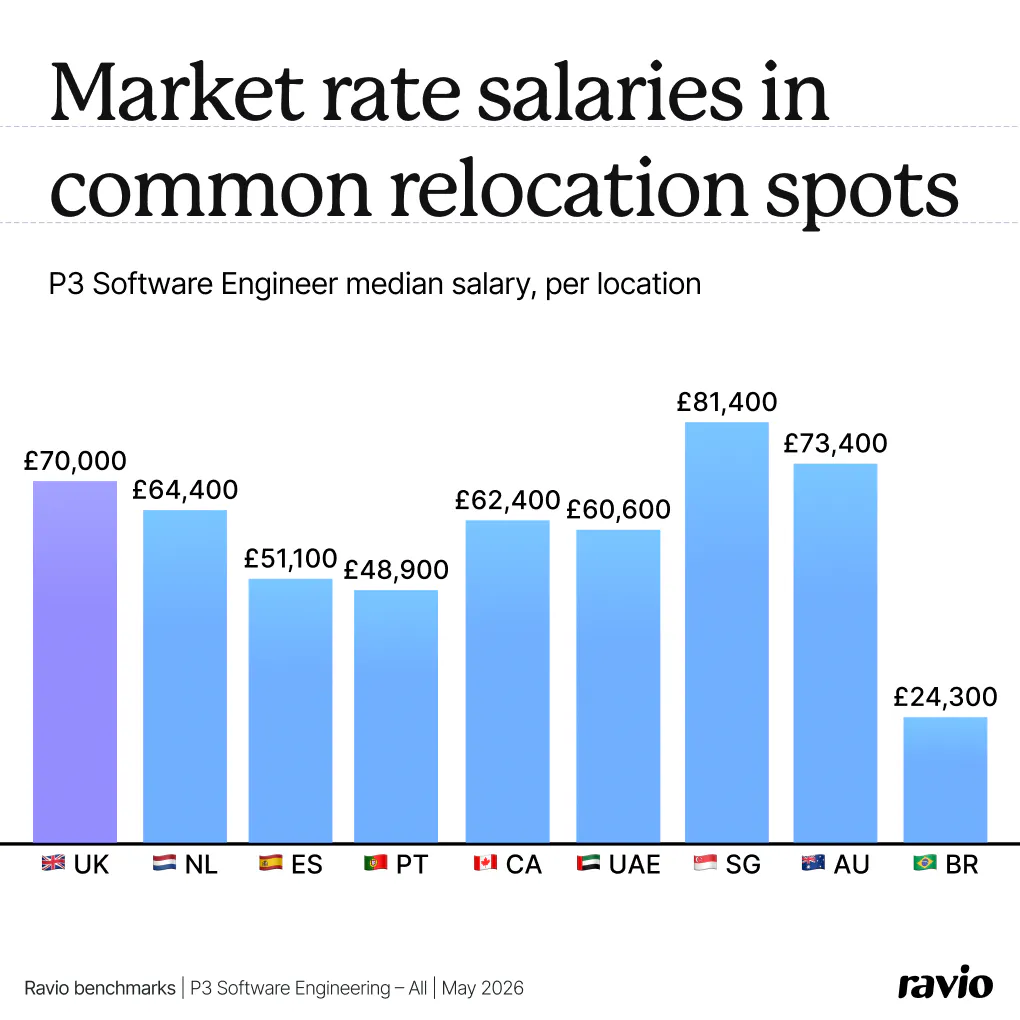
To illustrate how much salaries can vary across markets, take a P3 Software Engineer. In the UK, the median salary for that role is £70,000 – based on Ravio's compensation benchmarks (June 2026).
In some of the most common places to relocate to from the UK, it’s:

Some of these are close enough that – depending on your salary band structure – keeping salary consistent across the move is defensible.
Others, like Brazil or Singapore, represent a significant difference that's hard to ignore.
For those following a location-based approach, there are three common ways to structure the salary adjustment:

Whatever your approach, for Amanda, one principle should always be consistent: “compensation should follow the role, not the person”.
Amanda landed on this at Gymshark. "We had the issue of when we move somebody from Birmingham to the US, do we pay them what the US market says? Do we pay them what they're already paid in Birmingham? Or do we anchor it to a global pay scale?" she says.
Often companies will keep the relocating employee on their existing salary.
A respected employee is asked to move to a lower-cost location – the business wants to keep them, nobody wants the difficult conversation, so their salary stays put. Or an employee requests a move to a higher-cost location and the business agrees, but keeps the current salary to avoid additional costs.
They might seem like harmless decisions at the time, but the impact can quickly compound.
"When compensation follows the person, before you know it you've got an internal pay equity problem,” explains Amanda, “two people doing the same job in the same market, paid differently."
If you follow a location-based approach, the answer is usually yes – salary should reflect the new market, even if that means it goes down.
This is the decision that makes for the hardest conversation.
More on that in the difficult conversations section in step 4 below – but Amanda's starting point is to make the lifestyle tangible rather than leading with the number.
"Although the salary overall is decreasing, you can explain to them the type of lifestyle that they can still have," she says. "When salaries decrease, it's normally because they're moving to a country with a lower cost of living – and therefore what they should be able to get for their money should still be very similar."
A useful tool here is the compa-ratio: showing the employee that even if the absolute number is lower, their position within the salary band is the same and they're receiving equivalent value relative to their peers – it’s a fair outcome.
Salary is one piece. But as Amanda reflects on, it's rarely the part that makes or breaks the experience.
"When I relocated from the UK to Dubai, compensation was probably the least of my worries," she says. "Finding a house, finding schools for the children, navigating the tax situation of leaving the UK – there's lots to think about that I completely underestimated until I went through it myself."
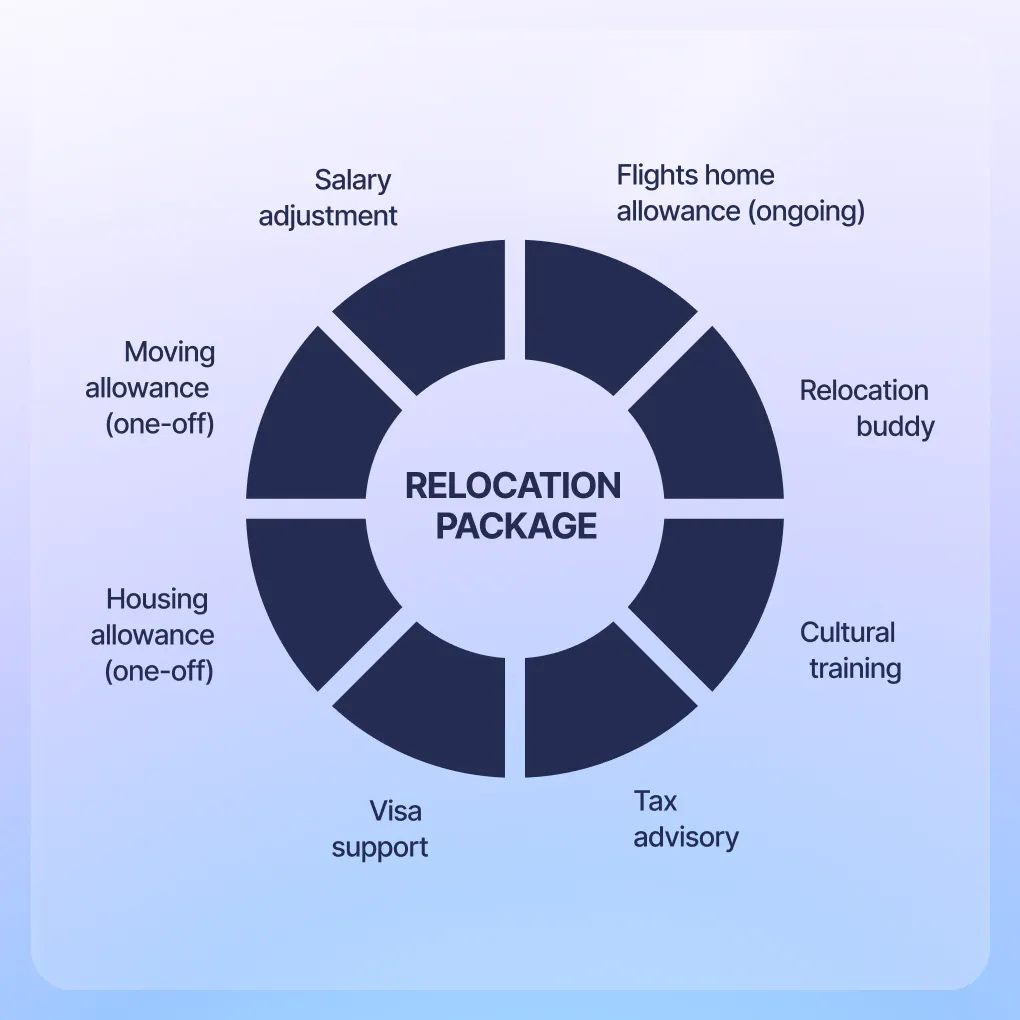
The relocation package covers everything the company provides to support the move beyond salary – and, as with salary, the package you land on should be led by your underlying framework, defined in step 1.
It typically includes a one-off allowance to cover the immediate costs of moving – and according to ARC Relocation data, the most common inclusions are:

As a rough figure to set expectations, Settly's 2024 Dutch Relocation Benchmark Report puts the average cost of relocating an employee in the Netherlands at €7,232.
For longer assignments, ongoing support may be included beyond the move itself, such as covering housing assistance, schooling fees, and regular flights home – though these tend to taper down over time as the employee settles.
Packages should be tiered to reflect the segmentation in your framework – a new hire relocation looks different to a business-critical employer-initiated move. The same line items might appear in both, but at different levels of provision.
Some companies choose to give the allowance as a lump sum, others will offer an itemised package with a set allowance for housing vs flights, and so on. Amanda’s preference is lump sum. "Everybody's situation is different and everybody stresses about different things – whether that's moving their pets, buying new furniture, whatever it is. The lump sum gives the most level of flexibility."
Beyond these standard inclusions, Liam and Amanda highlight a few elements that are easy to overlook and tend to matter most:
Designing an employee relocation package is often the easiest part of the process – and communicating that package to the employee the hardest.
Let’s walk through five of the most common employee relocation conversations and how to handle them:
When a move means a lower salary, the number can dominate the conversation before you even have a chance to explain how you got there.
Amanda's approach is to lead with lifestyle differences.
"Although the salary overall is decreasing, you can explain to them the type of lifestyle that they can still have," she says. "When salaries decrease, it's normally because they're moving to a country with a lower cost of living – and therefore what they should be able to get for their money should still be very similar."
Making that concrete helps – showing what accommodation, groceries, and daily life actually cost in the new location, not just presenting the new number in isolation.
The compa-ratio is useful here too, to show how this change is ensuring fairness is retained across the organisation: even if the absolute salary is lower, the position within the band is the same, and they're receiving equivalent value relative to peers in that market.
When a move is employer-initiated and the employee doesn't want to go, reaching straight for the package is rarely the right first move.
"Find out what their real reservations are," says Amanda. "Often it isn't the salary at all."
It might be schooling for the children, the partner's career, or simply not knowing how anything works in the new location.
At Gymshark, Amanda developed a practical relocation guide for exactly this situation – a document covering the new location in real terms: neighbourhoods, schools, healthcare, daily life. "It's all decisions that you have to make as a family and you don't even know how to go about them," she says. "Google only takes you so far."
When a move is truly business-critical, the framework may need to flex to create an exceptional package – but it should go through explicit leadership approval, not quietly become a precedent.
An employee works from another location for 30 days – that’s within your work-from-anywhere policy. Then they stay a little longer. And a little longer.
"These drifts do really happen now that remote working is more normal," says Liam. "And if you don't get it right, you're not only creating a lot of risk for the company, but a lot of personal risk for the employee."
Work from another country long enough and the employee can inadvertently become tax resident there – triggering obligations in both countries simultaneously. They may also be working without the legal right to do so, with no work permit or visa in place.
Regular check-ins – even a brief monthly touchpoint that confirms nothing has changed – create a paper trail and keep the conversation open.
When the drift can't continue, Liam is clear the conversation needs to happen early. "Sometimes you have to say: we're not actually doing the employee a favour by saying yes. The reason we're saying no is because of the risk it creates for them and us."
Six months after the move, everything seems settled – then a significant tax liability surfaces the employee didn't know was coming.
Equity can add to this too.
"You might have gone from a place where you are only taxed when you exercise the options or when the RSUs turn into shares,” explains Liam. “But you're moving into a place where they tax you as soon as they're granted. So as soon as you step foot on the ground, you effectively have a taxing event."
Tax advice before the move and a clear assignment letter specifying who pays what are the best defence against all of this landing as a surprise.
"By doing some of the pre-work upfront and understanding everybody's situation in its entirety, you can predict some of these problems," says Liam.
"Otherwise you end up with colleagues that are really frustrated, and potentially a retention challenge on top of an additional cost."
For employees on an Employer of Record arrangement, benefit gaps and communication differences can become apparent once they're in-country comparing their experience to colleagues.
"When you use an EOR, you need to go into it knowing it's not going to be comparable," says Amanda. "Have that honest, transparent conversation to say: your experience won't be the same and your benefits package won't be the same – but this is what we're going to do instead."
The conversation is much harder to have after the fact.
A relocation package typically includes a one-off allowance to cover immediate moving costs – temporary housing, flights, visa fees, and a miscellaneous expense allowance. For longer assignments, ongoing support such as housing assistance, schooling fees, and flights home may also be included.
It depends on your compensation philosophy. If you take a location-agnostic approach and pay all employees on a single global scale, relocation doesn't change anything. If you take a location-based approach and pay according to market rates in each working location, a move should trigger a salary adjustment to reflect the new market – in either direction.
If the company follows a location-based compensation approach, the salary should adjust to reflect the lower market – even if that means a pay cut. The key is to communicate it in context: a lower salary in a lower-cost location typically represents equivalent purchasing power and the same relative position within the salary band.
Tax equalisation is a policy where the company ensures the employee pays no more tax as a result of relocating than they would have paid at home. The employer covers any additional tax liability created by the move. It's most common for long-term assignments and is particularly important in the six-month to two-year zone, where employees can find themselves accumulating tax liability in two jurisdictions simultaneously.
A UK relocation package works the same way as any other – financial and practical support to help an employee move location for work. One thing worth noting for UK-based companies: HMRC allows employers to pay up to £8,000 towards an employee's relocation costs tax-free, provided the move qualifies under their rules. Anything above that threshold is treated as a taxable benefit.
The three most common are home-based (salary stays anchored to the home country, with cost-of-living allowances added), host-based (salary moves to the market rate of the new location), and local plus (host-based salary with select allowances on top to cover expat-specific costs like international schooling or home leave).
Ravio's guide to employee relocation packages covers everything from building a relocation framework to salary adjustments, package design, and the difficult conversations that come with moves. For broader global mobility guidance, CIPD also publishes resources on international working and employee mobility.
Based on Ravio's benchmarking data, a P3 Software Engineer in the UK has a median salary of £70,000. The equivalent role in the UAE benchmarks at £60,600 – around 13% lower. Whether that triggers a salary adjustment depends on your compensation philosophy, but for companies following a location-based approach, the UAE rate would apply.
Based on Ravio's benchmarking data, a P3 Software Engineer in the UK has a median salary of £70,000. The equivalent role in Australia benchmarks at £73,400 – slightly higher than the UK. For companies following a location-based approach, an upward adjustment to reflect the Australian market would apply.
Your monthly dose of market insights and expert perspectives

From free salary calculators to real-time benchmarking platforms, the options are wide – and the quality varies enormously. Here's every type of salary benchmarking tool compared for 2026.

Bigger datasets tend to be broad but not always reliable. Learn how Ravio prioritises data quality over quantity to give fresh, accurate, and relevant pay benchmarks.

Amanda Moore (Senior Director, Reward, Performance and Analytics at Beyond ONE) and Liam Bax-Branagan (Director, Head of People Operations and Compensation at European Energy) discuss how to handle employee relocation from a reward perspective.