
Pay equity
EU Pay Transparency Directive: the complete guide for employers (2026)
What the EU Pay Transparency Directive requires, how each member state is implementing it, and what employers need to do to comply.


Pay equity has gone from a background concern to something HR and Reward leaders are being pushed on from every direction at once.
Legislation is coming whether you're ready or not, with the EU Pay Transparency Directive introducing mandatory gender pay gap reporting and a 5% threshold that most European tech companies will need to interrogate closely.
Employees are asking questions – and that same legislation will give them the right to demand answers – and leadership wants to know where the company stands before reporting obligations arrive.
It’s also one of the toughest areas of Rewards to work on.
One-off fixes don’t solve it. It takes deep analysis to find the gaps, understanding of where they come from, and building the processes that stop them increasing over time.
This guide covers everything People and Reward Leaders need to know: what pay equity actually means, why it matters for the business, how to run a rigorous pay equity analysis, how to close the gaps you find, and what tools can help.
Pay equity is the principle that employees should be compensated fairly for their work, regardless of gender, ethnicity, age, disability, or any other protected characteristic.
It guarantees equal pay for equal work or work of equal value.
This is important because, in practice, that principle is widely unmet. Compensation decisions are shaped by bias – in hiring, in performance ratings, in how different roles are valued and who they’re accessible to – which means we’re left with pay gaps based on inequity.
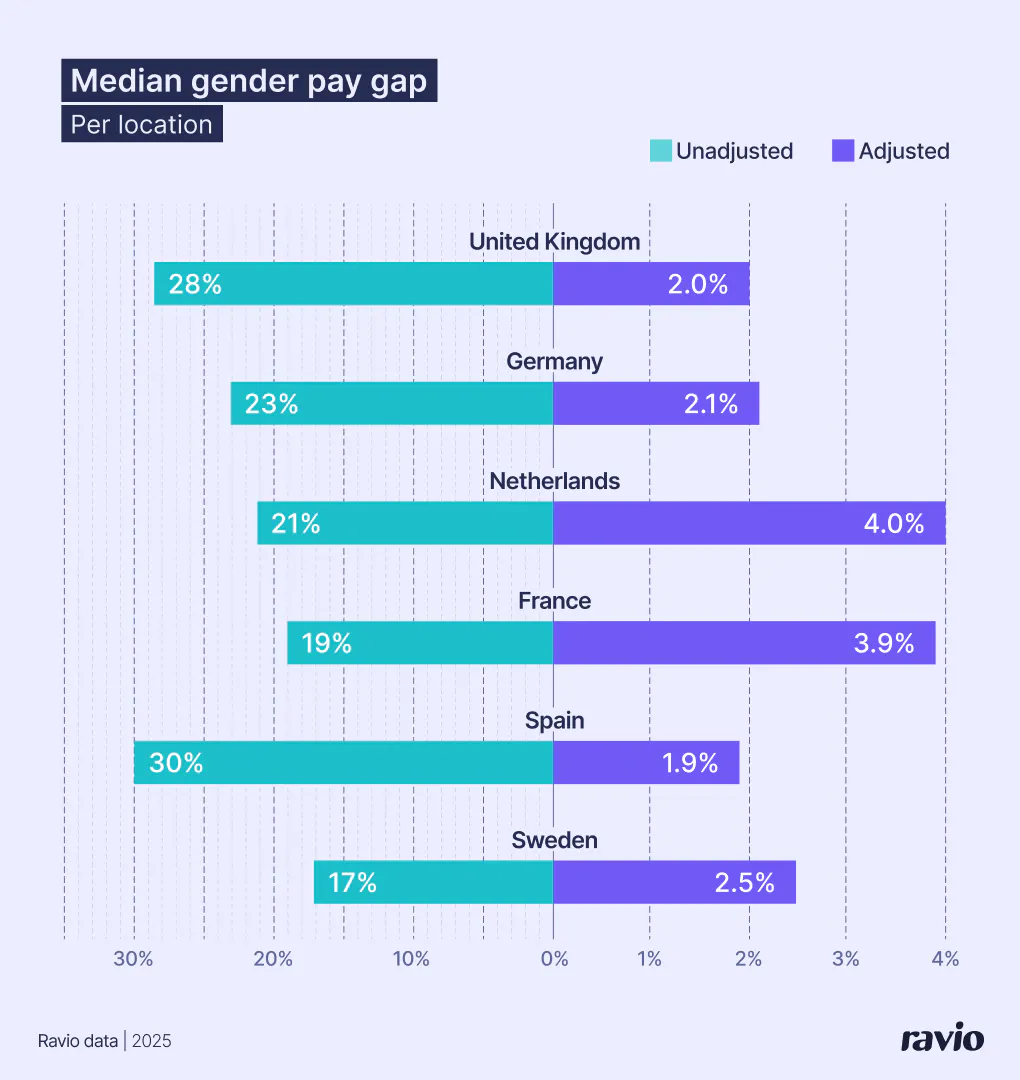
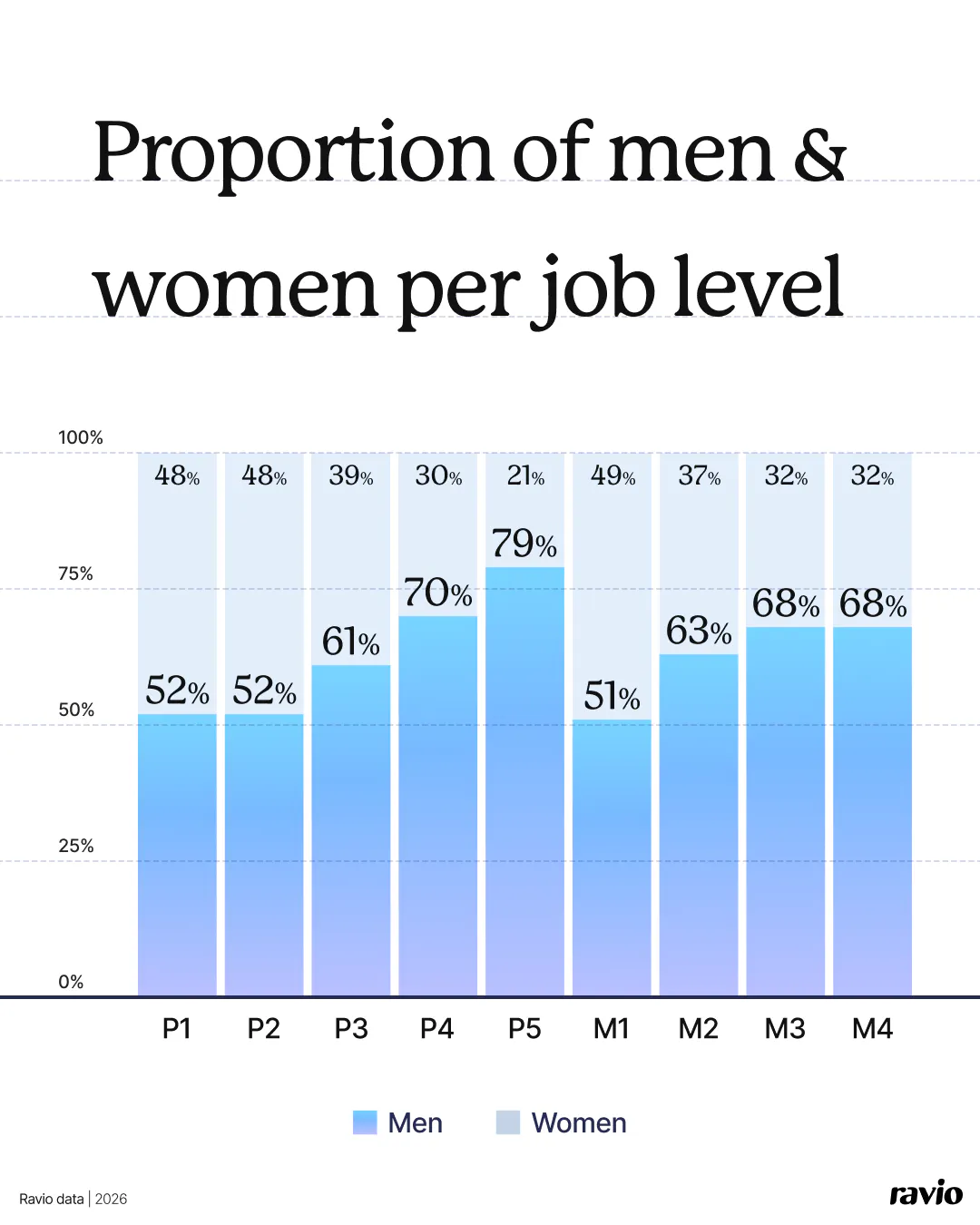
The gender pay gap across Europe stands at 23% unadjusted and 2.4% adjusted (Ravio Compensation Trends report 2026).
The raw earnings difference (unadjusted) is largely driven by representation, not by unequal pay for equal work. But a 2.4% adjusted gap means that women doing equivalent work to men still earn less.
These three terms are often used interchangeably, but they're not quite the same thing – so let’s be clear on how they’ll be used in the rest of this article.
Pay parity means paying employees the same amount for the same job. It's the most literal interpretation of equal pay – two people in the same role, at the same level, receiving the same salary, regardless of any differences in gender, race, or other protected characteristics
Pay equality is the same as pay parity – two employees who perform the same role should be paid equally, allowing for no discrimination based on gender, race, or other protected characteristics.
Pay equity takes it a step further, meaning equal pay for equal work or work of equal value – not just employees performing the same role, but evaluating the relative value of all job positions and ensuring that different roles of equivalent value are compensated fairly relative to one another. This is a more demanding standard, and it's the concept at the heart of much pay equity legislation – like the EU Pay Transparency Directive for European companies.
Pay equity has always been the right thing to do. But today there are also a breadth of business consequences when it's not managed well – across retention, performance, talent attraction, and legal compliance:
A pay equity analysis is a systematic review of your employee compensation data to determine whether employees are being paid fairly across protected groups.
Running one rigorously means following a clear process and being honest about what you find.
As Isha Smith, Global Head of Rewards at Soundcloud, puts it: "Introspection is crucial when it comes to pay equity. If you aren't able to look inwards and really dig into why pay discrepancies exist within your company's structure, systemic biases and pay equity issues may never come to light."
Here’s the 7 key steps involved in conducting a pay equity analysis:
Before pulling any data, decide what the analysis is going to cover.
💡 Which employee groups have the highest risk of pay equity issues?
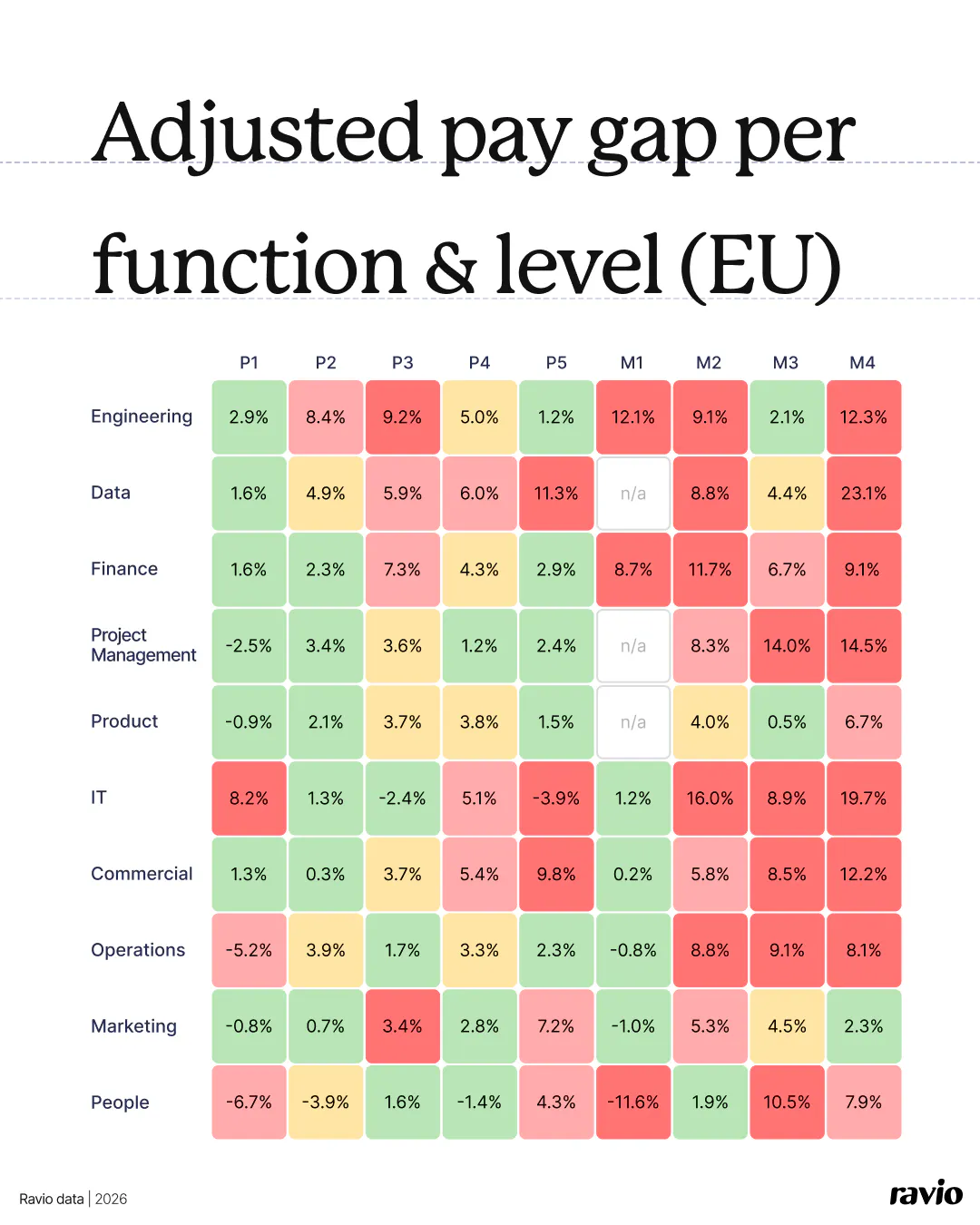
Ravio's analysis of gender pay gaps across European tech identifies three risk factors that are most likely to produce adjusted gaps above 5%:
And then there’s the intersection – when function and seniority combine, we see gaps become significantly more pronounced. M4 Data shows a 23.1% adjusted gap; M4 Engineering 12.3%.
See the full analysis of which employee groups are most at risk →
A pay equity analysis is only as good as the data underpinning it.
You'll need employee compensation data (base salary, actual bonus paid, equity grant value, total compensation) alongside their job level, job function, location, tenure, performance rating (if applicable), employment type, and protected characteristic identifiers.
Most of this can be extracted from your HRIS and payroll systems – or your compensation system if you use a tool like Ravio.
Clean and validate the dataset before you start analysing – check for missing values, inconsistent job titles, and level mismatches between systems. Missing or bad data can distort the entire analysis, so this preparation step is often where the most time goes.
Before you can compare pay fairly, you need a consistent view of the relative value of every role in the business.
This is where job evaluation comes into play – a structured methodology (like the point factor method or job ranking) that assesses each role against objective criteria such as skills, effort, responsibility, and working conditions, producing a comparable score or ranking across the entire organisation.
The output of that process is your comparable groups: sets of roles that score equivalently and therefore represent work of equal value.
These groups are what make the pay gap calculation in the next step meaningful – rather than comparing pay across the whole organisation or within arbitrary function boundaries, you're able to compare pay between employees whose work has been assessed as equivalent.
Any gap that exists within those groups can't be explained away by differences in role or seniority, which means it needs a legitimate justification or it needs to be fixed
For EUPTD compliance specifically, job evaluation is the mechanism for defining your "categories of workers performing equal work or work of equal value" – the groups within which the Directive requires you to report your gender pay gap.
With your comparable groups defined, you can now calculate the pay gap in a meaningful way. Most organisations look at this at multiple levels – starting broad and working towards the more granular analysis that actually tells you whether pay discrimination exists.
What to include in your calculations:
For most People and Reward teams, the comparable cohort approach is the right level of rigour for a routine analysis – it enables you to understand which factors are impacting pay equity in your organisation, and it prepares you for legislative requirements.
Start with the overall company gap as your baseline, cut by function and level to find concentrations, then calculate the gap within your comparable groups to identify where genuinely equivalent employees are being paid differently.
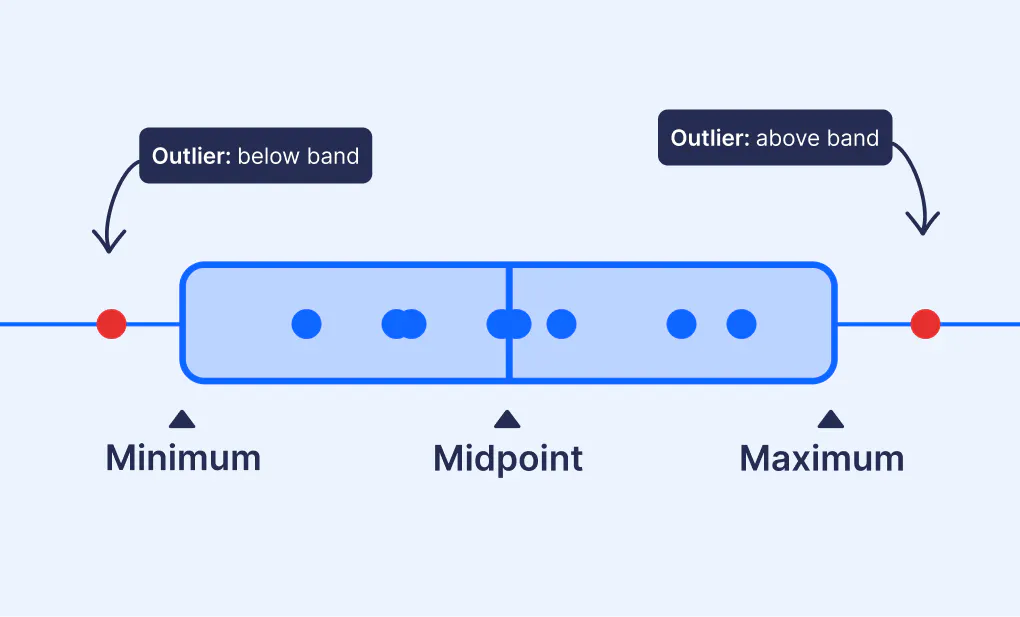
Alongside the gap calculation, it’s worth examining where employees sit within their salary bands, broken down by protected group – using compa ratio or salary range penetration as the measure.
If women and men in the same cohort have the same median salary, but women cluster consistently in the lower half of the band while men cluster in the upper half, there's a systematic pattern in how pay decisions are being made that will compound over time as those employees receive percentage-based increases.
For Isha Smith, salary band position analysis should be a standard part of every pay equity audit, and can tell you where to start with making improvements. "If you identify that salary band outliers tend to be women – or that female employees are generally in the lower part of the band whilst men are in the upper – it's well worth interrogating your hiring process," says Isha. "Those discrepancies don't appear by accident."
Don't just analyse the current state of pay – examine where gaps are introduced and how they develop over time.
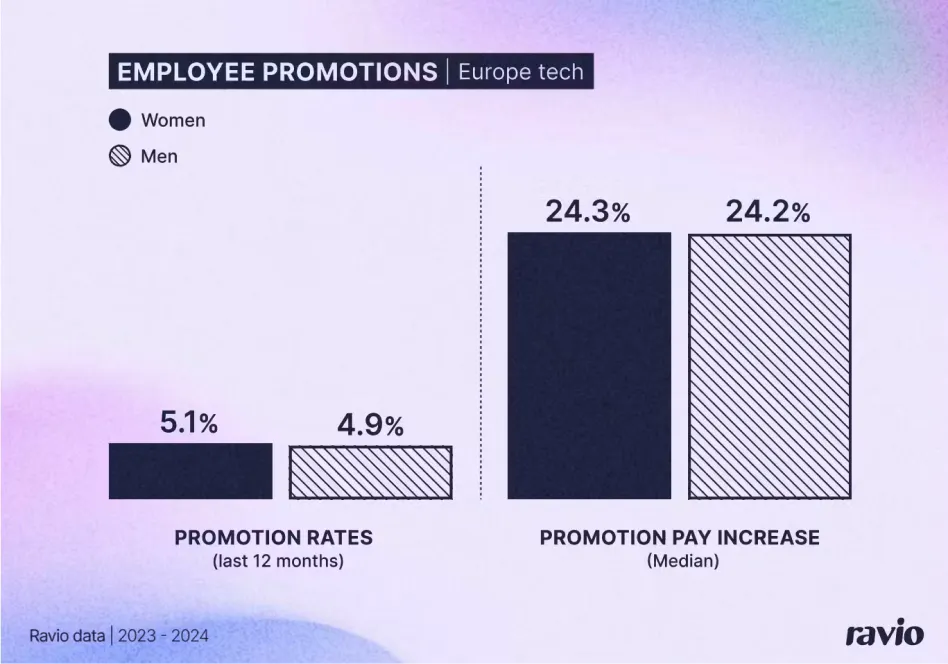
Compare starting salaries for new hires broken down by protected group, promotion rates and promotion pay increases by group, and merit increase percentages by group.
As Matt McFarlane, Director at FNDN, observes: "Companies publishing their data and checking the compliance box are not addressing root causes.”
“Transparency alone doesn't fix systematic pay equity issues – it's the promotion patterns, role levelling inconsistencies, negotiation biases that need to be looked at deeper."
Ravio’s data, for instance, finds that the gender pay gap in tech is largely introduced at the point of hire, not through internal progression. Men and women in European tech have similar promotion rates of around 7-8% – which means that the gap that exists in current salaries was most likely there from day one. If that’s true in your organisation, hiring is the place to focus in terms of action.
Document the analysis and use it to build a remediation plan.
That plan should include immediate fixes: adjusting pay where disparities are unjustified, prioritising the most significant gaps first.
And it should also include interrogating the root causes: if gaps are entering at hire, the hiring process needs to change. If they're concentrated in a particular function or management level, the compensation decisions being made in those areas need scrutiny.
Fixing current outliers without addressing what created them means the same gaps will reopen in the next review cycle.
Present the plan to leadership with clear ownership, timelines, and budget implications. Pay equity fixes won't happen without executive buy-in, and the data from the analysis is what makes that conversation concrete.
Once the plan is in motion, communicate it.
Being transparent with employees about findings and next steps – even when the results are uncomfortable – builds significantly more trust than treating pay equity as an internal compliance exercise.
Employees don't need to see every number, but they do need to understand that the organisation takes this seriously, what it found, and what it's doing about it.
Pay equity isn't a one-time project.
Markets shift, organisations restructure, new people are hired –gaps can reopen quickly if they're not actively monitored.
Build pay equity analysis into your regular compensation review cycle so it's reviewed at least annually, disparities are caught early, and the fixes you've made don't quietly unravel over time.
Understanding where pay gaps come from is the first step to closing them. The actions you take will depend entirely on what the root causes look like in your specific organisation – which is why the audit comes first.
A pay equity analysis tells you where gaps exist. The harder work is understanding why.
For each gap identified, interrogate the mechanism: is it in starting salaries, in merit increases, in promotion rates, in bonus eligibility? Is it concentrated in a particular function, manager, or hiring cohort?
The findings determine the fix. The most common root causes in European tech are:
Once you've identified employees paid below where they should be – whether below their salary band or below their cohort peers after controlling for legitimate factors – address those gaps and outliers directly through pay adjustments.
For underpaid employees, the aim is to bring salary into equity with peers as quickly as budget allows – ideally immediately, or through incremental increases within the normal review cycle if not.
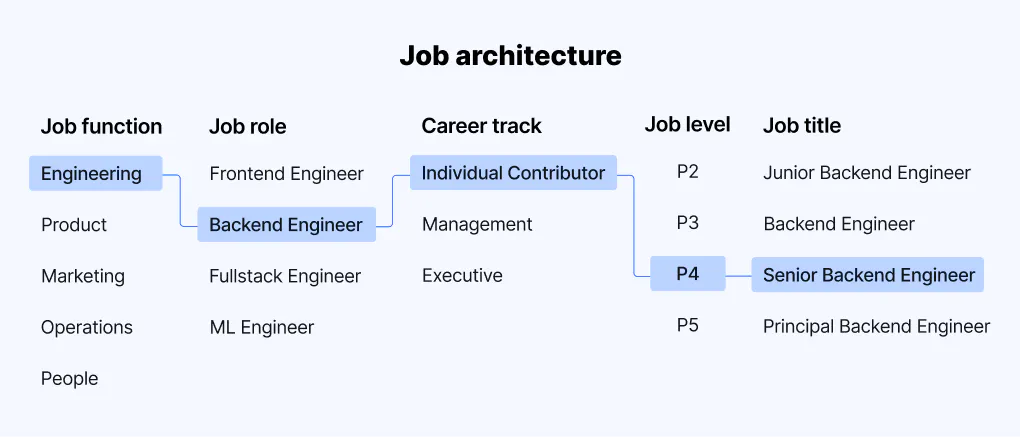
Without the right underlying structures, compensation decisions default to individual judgement – and individual judgement is where bias enters.
Monica Öberg, Fractional HR Leader and Pay Equity Consultant, puts it simply: "Job levelling is the most natural place to start. Well-defined levels give you an anchor for salary offers and promotions, which removes a lot of bias and back-room negotiating that leads to inequity."
The foundational elements are:
Together, these structures shift compensation from a series of individual decisions to a consistent, documented process – which is both the practical foundation for pay equity and, increasingly, a compliance requirement.
If the audit points to hiring or compensation review processes as the source of gaps, those processes need to change – not just the outcomes they're producing.
On hiring:
On compensation reviews:
Running a pay equity analysis in a spreadsheet is possible, but it's slow, error-prone, and increasingly impractical as the analysis needs to become a regular part of the compensation cycle rather than an annual project.
Dedicated pay equity software automates the data collection, statistical analysis, and reporting – making it significantly easier to identify where gaps exist, understand why, and track whether remediation efforts are working over time.
Most platforms integrate directly with your HRIS and payroll systems to keep data current, offer dashboards that let you cut the analysis by function, level, location, and protected characteristic, and produce reports that can be shared with leadership or used for regulatory reporting.
The main options in the market serve different needs and organisation sizes.
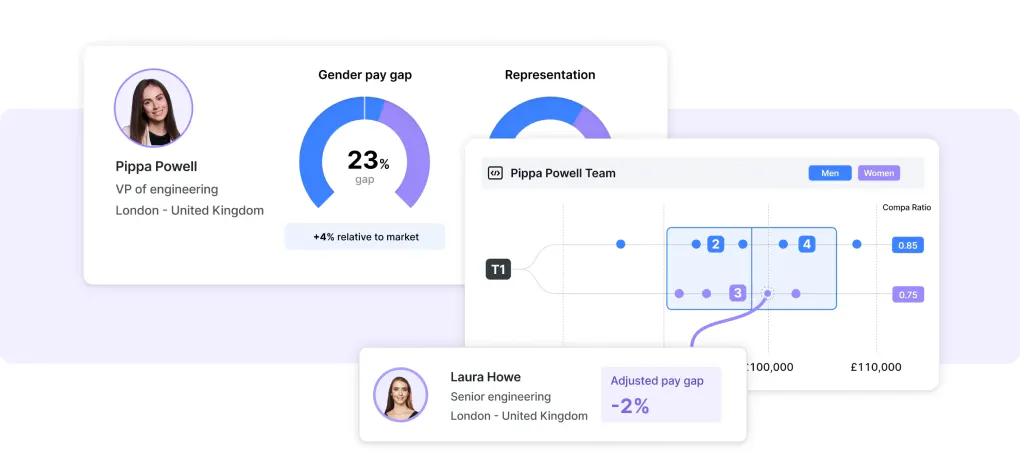
Ravio’s pay equity analysis tool sits within a broader compensation management platform – combining pay equity analysis with salary benchmarking and salary band management in a single tool.
Pay equity analysis is broken down by job function, level, and location, and sits alongside real-time market benchmarking data, making it straightforward to identify where gaps exist and whether they reflect market positioning issues or internal equity issues.
Ravio’s pay equity module is well-suited to European tech companies that want pay equity analysis connected to their day-to-day compensation decisions rather than treated as a separate compliance workstream.
Syndio is the largest specialist pay equity platform globally, used primarily by large enterprises. It uses regression analysis to identify and explain pay gaps across gender, race, ethnicity, and other demographics, and includes tools for modelling remediation costs and ongoing monitoring.
Syndio is strong on analytics depth and compliance reporting; but enterprise pricing may make it less accessible for smaller organisations.
PayAnalytics (by beqom) is a specialist pay equity platform with strong global compliance coverage, including EUPTD reporting.It includes job evaluation tools for defining comparable groups, regression-based gap analysis, and budget-optimised remediation recommendations.
It’s well-suited to organisations with complex global workforces and significant compliance requirements.
PayParity is a purpose-built pay equity platform focused on rigorous statistical analysis across multiple protected characteristics simultaneously – gender, race, age, disability, and their intersections.
It includes AI-powered remediation tools that identify the most cost-effective adjustments to close gaps, and covers compliance reporting across global jurisdictions including the EUPTD. It’s primarily suited to larger enterprises with mature pay equity programmes.
Gradar is a job evaluation and compensation platform that uses a point-factor methodology to grade every role in the business against objective criteria, then layers pay equity analysis and gender pay gap reporting on top of that foundation.
It combines job architecture, salary band management, market benchmarking, and equal pay analysis in a single platform.
Gradar is well-suited to organisations that need to build or formalise their job evaluation framework as part of their pay equity work, rather than organisations that already have a mature job architecture in place and need deeper statistical analysis of gaps.
Brightmine combines pay equity analytics with HR compliance resources and UK salary benchmarking data. Its pay equity module provides continuous monitoring of pay gaps across demographics, forecasting and predictive modelling, and reporting tools.
Brightmine is best suited to UK-based organisations that want pay equity analysis integrated with employment law guidance and UK-specific benchmarking.
Your monthly dose of market insights and expert perspectives
What the EU Pay Transparency Directive requires, how each member state is implementing it, and what employers need to do to comply.

Use Ravio to identify pay gaps across your organisation, understand what's driving them, and calculate the cost of closing them.

A complete guide to pay transparency in France: current law, what the EU Directive changes, how France's draft transposition bill goes further, and how to prepare for compliance.

